February Analytic Blog Post

The above image shows President Obama at one of his many visits to Walter Reed hospital, where hundreds of wounded veterans go to recover and engage in physical therapy. In this particular image, he is doing lunges with Lieutenant Commander John Terry during the commander’s physical therapy. This action demonstrates an example of one of president Obama’s prudent performance fragments, as it reinforces the ideals of the mythic presidency, his power and his leadership.

According to Erickson (2003), the mythic presidency consists of a balancing act between performing out of political necessity and based on phronesis, or ethics, while also managing a presidential personae (p. 142). Being a Democrat, Obama was often criticized as being too pro-gun control and also not being as concerned or supportive of veterans. This performance fragment is used to reinforce his presidential personae and is used politically to show the public that despite being a Democrat, he does in fact support veterans. Obama wants to avoid being labeled as “veteran-hating,” so this performance fragment reinforces his personae that he is supportive of them by showing him engaging in physical therapy activities with them. Seeing Obama take time out of his busy schedule to visit the wounded veterans and spend time with them shows the public that he does truly care, and it reinforces his authority and his role as commander in chief to the public. Ideally, this fragment is founded out of phronesis, or ethics, for Obama to volunteer with people in need, but regardless if that is the case, the gesture is seen as genuine and reinforces this concept of the mythic presidency.

Obama’s performance fragment is also seen as prudent because the image reinforces Obama’s power. The above performance fragment reinforces President Obama’s power by targeting marginalized audiences and aligning with symbols of patriotism. Veterans are a group of people that are in the minority, so by engaging with wounded veterans and being seen doing it, it signals to the public that Obama feels concern and respect for these veterans. In terms of semiotics, by visiting the wounded veterans, it associates Obama with a symbol of patriotism. According to Goodnow (2010), semiotics are elements that give meaning to images (p. 408). For this image, the elements are the veterans, which give the image a meaning of patriotism. In America, being a veteran is seen as the ultimate patriotic act. After all, there is no clearer way of showing how proud you are to be an American than being willing to fight and die in the name of your country. By visiting these wounded veterans, Obama aligns himself with patriotism, a symbol that is very important in American society.  By aligning himself with this essential American value and by approaching a revered marginalized community, Obama reaffirms his power to the public.

Finally, Obama’s performance fragment is also seen as prudent because it reinforces his leadership by linking his performance with a political issue. By showing himself working with wounded veterans and visiting wounded veterans, it raises awareness of veterans’ quality of life. It makes the public aware of just how many veterans are wounded and having to try to adapt to a new way of life. The treatment of veterans was one political issue that both President Obama and Michelle Obama really tried to help with. By performing with veterans, this fragment not only raises awareness of the issue with the public but also causes the public to feel concern and sympathy for those veterans. These emotions are used to heighten concern about this political issue and to reinforce Obama’s active leadership by showing him trying to improve the treatment of veterans.

Analytic Blog Post #2

For my blog post, I wanted to explore McCloud’s analysis of icons and cartoons and since McCloud used comics to convey his point I thought I would use an image from the comic Justice League: Kingdom Come as the basis for my analysis. This image unlike much of what McCloud discusses does not leave many gaps for the mind to fill in to understand what the image is attempting to convey. The icon in question is very clearly a group of colorful individuals drawn very realistically. Because of this, it is very simple for our minds to immediately establish what is happening in this picture: a group of superheroes looking very forlorn due to some assumed tragedy. The reason for this identification is because of an extension of self that we can attribute to this group of heroes that we create subconsciously.

I feel that this semi-realistic portrayal also tows the line between the realm of the senses and the realm of the concept that McCloud discusses. As this is not so much a cartoon as it is an accurate portrayal of humanity, both in the physical and emotional sense, there

This appearance, as opposed to the much less detailed and cartoonish aesthetic of its contemporaries seeks to establish not only a different tone but a different idea in the mind of the viewer. Without knowing the context behind this image, the viewer can establish the gravitas of the situation just by the art style and the conflicting mood emphasized by the emotions and the colorful costumes of its subjects.

The background also works to emphasize the meaning of this image, which is not what one would initially assume considering the seeming lack thereof. The pronounced blankness of it gives more definition to the characters that are encompassed within it, drawing forth a slew of new emotions. It conveys a despair to the characters which the viewer then can experience vicariously, which I feel is one of the more powerful aspects of this image. It seems like such a simple detail, almost as if the artist just left it out due to time constraints, but on reflection there are many interpretations that can be made of this simple omission.

It should also be noted for the cultural aspect that the characters portrayed are relevant to most potential audiences. Most people would look at this cover and see a despondent Superman or The Flash and connect with it in the sense of the public conscience, allowing the reader to mask themselves and enter this image in a metaphysical sense.

So that begs the question of what meaning can be obtained from this one image. To add a little more context, Kingdom Come is a story about the end of the era of the Justice League and the rise of new, more extreme and violent heroes. Based on that fact alone, we can make connections about what the image represents with all of these moving parts. Using the writer’s perspective on this image, we can even further begin to understand all the emotions associated and conveyed. By combining the language of word and image, we can more fully begin to understand what we are seeing and connect with the image on a more personal level.

Analytic Blog Post– February

The importance of the audiences’ understanding of the naturalistic enthymeme is a concept that can be traced back to the series of pictures by Arthur Rothstein during the Great Depression. In the article “The Naturalistic Enthymeme” by Finnegan the naturalistic enthymeme is described as a belief that photographs are inherently true depictions of the experiences around us. The article goes onto to discuss the skull controversy, one of the first times the naturalistic quality that photographs have was called into question. Since that time, the doctoring of pictures has been almost commonplace. From filters, to face correcting apps, to photoshop, it is hard to find a picture that is not doctored before being published to the internet.
For this blog post, I wanted to look at an important cultural moment that also called into question the truthfulness that pictures often have—the depiction of OJ Simpson on the cover of Newsweek and Time. As discussed previously in class, Time magazine’s use of a filter that made OJ appear darker changed the public’s opinions of his crimes.  In this particular case, the consequences could be linked to the publics’ harsh scrutiny of the media and the truthfulness of reporting. In the article by Farrell that we discussed a while back, the use of images and texts made the audience has a better understanding of what the horrible famine in Ireland looked like, and ultimately gave the public a sense of understanding of the of the event because of the media, however, in the case of the OJ Simpson cover photo, the doctoring of the photo turned the public against the media. When the public feels like the media has changed or manipulated a photo, which they perceive to be the truth, it changes the meaning and the willingness of the public to trust the accuracy of what the audience is seeing.
In the article “Don’t Believe What You See In The Papers” by Lewis, it is asserted that people are more likely to believe a photograph based on the similarity of the presentation much like what the human eyes see. The doctoring of photos has become commonplace even in news and magazines, making it harder to understand the difference between what is real and what is exaggerated. In this sense, Lewis’ argument toward both the skull argument as well as the OJ covers would be that because of our experiences with doctored pictures, “we will approach each photograph we look at with the condign skepticism we bring to each story we read”.

As time has given us more technological advances that also has given us more ways to question what is shown to us with little explanation. The doctoring of pictures has changed the way that as a public audience we perceive images to be truthful, reminding us of the naturalistic enthymeme from Finnegan’s article. As we move forward, the solution to the problem is not changing the media, but rather changing the audience’s understanding that most of what we see is now doctored.

Analytic Blog Post 2

Related image

For my blog post I chose to use Foss’ schema to analyze an image through his three step process.

The first step in Foss’ scheme is to identify the function that is being communicated in the image. In this case, the function of this image is expressing to the viewer that if an adult is abusing an animal that the child will be next. The first thing I see is a blatant abused animal covered in blood and then an adolescent with the words, “he’s next” under him. The following text says to report animal abuse to stop domestic abuse by calling 911. The image is bringing awareness that if you see animal abuse report it because you could stop the abuse of a child. If there was no text accompanied with the images we would be confused as to why an abused animal picture is next to the boy.

The second step is to determine how well the function of the image is being preformed. The blood covered dog and the transition into the child is stimulating emotion to the viewer by saying the child is next to be abused. The frightened looks in the eyes and faces of both the dog and the boy evoke an emotion that causes the reader to want to take action. Most everyone loves animals and no sane person would wish abuse upon a child so the pathos appeal to the viewer makes this image function well.

The final step in Foss’ schema is to analyze the legitimacy of the image. The function of the image is to bring attention to viewers that if you see animal abuse then report it because you could stop child abuse. The function is not completely legitimate. Not 100% of all animal abusers are harming children, but it is bring attention to the fact that if someone would harm an animal, then they could harm a child. Although it might not always be happening, it is better to be safe and report all abuse.

Mini Blog Post 3

Image Credit: Alfred Eisenstaedt

Enthymemes are rhetorical devices that allow the user to keep one premise implied or hidden. This type of device is often used to influence the audience and allow them to make connections and inferences based on a cultural understanding. Finnegan in the article, “The Naturalistic Enthymeme”, describes the difference between naturalistic and unnaturalistic enthymemes. An important distinction on what a naturalistic enthymeme is made on page 135 saying, “because we perceive photographs as fundamentally ‘realistic’, we make assumptions about their argumentative potential… we assume photographs to be ‘true’ or ‘real’ until we are given reason to doubt them” (Finnegan, 2001). The picture I chose is the famous picture of the sailor and the nurse kissing on V-J Day in 1945. This picture is a great example of an enthymeme because as a viewer, without context, the couple is believed to be in love or at least emotionally involved, but they were strangers celebrating. The unexplained premise of this photo is that the joy of the advancement of the war toward being over is contagious. Since this photo is older, it is a good example of audiences that would have fallen into the belief that this photo is naturalistic since it was before the era of doctored photos.

MBP #3


Child Attends Funeral Of His Dad


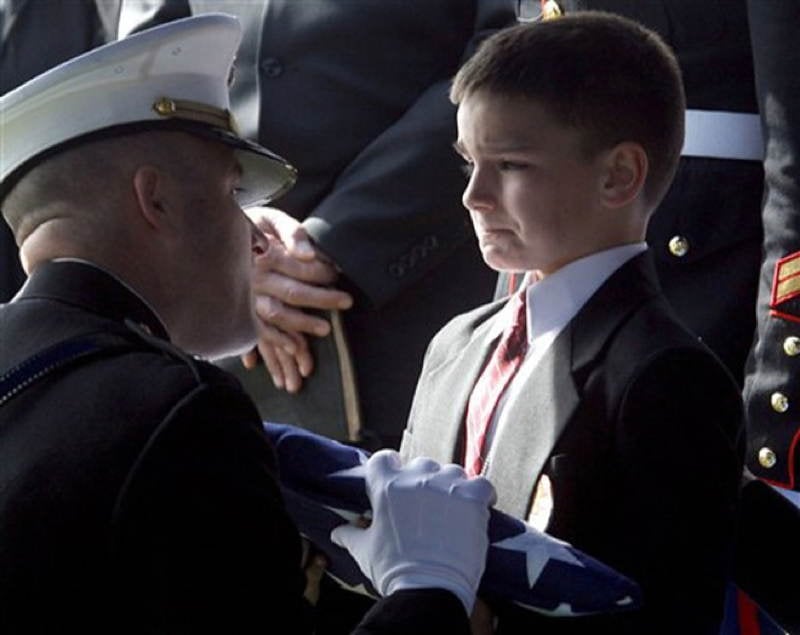
An enthymeme assumes the premise that the image is essentially natural and has now been provided by the audience. Finnegan says the visual arguments are identified as demonstrative and rhetorical. Images work to convey a message to the audience, often using things such as enthymemes. It is when an image is natural, and not staged, that it has a great impact on the audience. An example of this can be seen the picture above. There a few things in this picture that are factual, that can be known. On the other hand, there are things in this image that are implied. The first premise that can be clearly seen in this picture is that a soldier of the U.S. Military is giving a folded up flag to a boy. He is dressed in his full military attire and giving a flag to a boy dressed in all black. He is also kneeling down, which is a sign of respect, while he gives a flag to an emotional boy. The second premise is that this image was taken at the moment is occurred in order to document the moment. This can be believed to be true until proven otherwise according to Finnegan (135). The third premise is that the picture was not staged, but is authentic. This image is realistic due to the careful analysis of the things we know to be true and consistent. Through looking at the context and cultural norms of this picture, it can be stated that this is a naturalistic enthemyme, and not thwarted by any outside force. Finnegan claims that the visual argument is reliant on visual culture because it enables an image to have context to support a natural enthymeme. 

Mini Blog Post #3

Nick_Sandmann_Jan._18__2019_810_500_75_s_c1

This image of a Covington High School Student staring down and seemingly mocking  Native American activist, Nathan Phillips, went viral earlier this year because of the narrative that it seemed to carry. This picture is a perfect example of a naturalistic enthymeme, because it gives an argument regarding the attitude of American teenagers in the era of Trump. An enthymeme is an argument that has an assumed premise, a naturalistic enthymeme relates to images because the assumed premise is that the images are real in all three parameters of realism as laid out by Don Slater. The first premise this image is that this image is “a representation of something in the world (Finnegan, 143)”; since the 2016 election of Donald Trump, there has been a lot of tension between people of differing political dispositions. This angst caused by the election of Trump makes it reasonable to believe that this apparent harassment is representative of the tension already present. The second premise in this image is that it is “actually occurring before the camera at a particular time or place.” The assumption is simply that what is being seen is actually what was occurring the moment the picture was taken and that the context supports the narrative of the situation. The third and final premise is that the picture was “captured by the camera with not intervention from the photographer.” This is simply an assumption that the photo was not staged and was not photo-shopped. The reason why this image is a perfect example of a naturalistic enthymeme is that when more contextual information surfaced about incident captured on camera, it was shown that the argument being made was based on false premises. The incident portrayed on the camera was not supported by the context of the situation, and therefore, the situation was not a representation of a larger political problem of harassment. In fact, this situation led to another naturalistic enthymeme that assumes the premise that this situation was a representation of the misleading nature of the mainstream media.

Mini-blog post 3

Looking over the post prompts, I decided to write my post over a memes and how they are examples of an enthymeme.

A meme is a viral sensation within social platforms and society today and are easily recognizable that can represent a wide variety of issues and subjects. They are the easiest way to grab someone’s attention because almost anyone will take the time to read a meme, no matter how bad or stupid it may be.

An enthymeme is defined as a syllogism in which the premise of the image is left out of the argument. Having a social norm or understanding about the image between the creator and the viewer is important so that the underlying meaning of the image can be be understood.

A trending social word easily recognizable in todays society is “triggered” and what better representation of the word with an enthymeme than the “triggered lady.”

Related image

This image is an example of an enthymeme because we can look at the image and get an understanding that the individual is upset and ready to blow off all the steam she has. This person has been a popular meme and has been defined as “the triggered lady.”

MBP #3

Memes as examples of enthymematic reasoning:

Memes are a staple of today’s internet. “Meme” originally was a term coined by Richard Dawkins in his book “The Selfish Gene.”  Dawkins believed ideas, notions, and behaviors were influenced through evolutionary methods. Dawkins believed that if a shared behavior or notion was popular enough in a successful community, then it would show to have positive effects on gene survival. Dawkins claimed memes needed to be replicated and reproduced through populations. The internet “meme” has spearheaded the meaning of “meme.” Dawkins’ term for meme and the modern internet meme are not far off from each other.

A strong case could be made that religion is a meme embedded within our culture. Certain religious beliefs have positive effects on societies, which is why these rites have been successfully passed down for so many generations. If religion has survived this far, there is a biological and evolutionary reason for its constant existence.

Today’s definition of “meme” is a viral, easily-replicable, shared set of experiences that invoke laughter, emotion, or humor. Memes become viral and are predicated by a shared understanding of certain behaviors or cultural beliefs.

An enthymeme is a syllogism in which a premise is left out of the argument. It is important that the left out premise is understood by the audience. The shared understanding of this missing premise between the creator and viewer, and the shared understanding between the viewer and other viewers is critical for the popularity and viralness of the modern day “meme.”

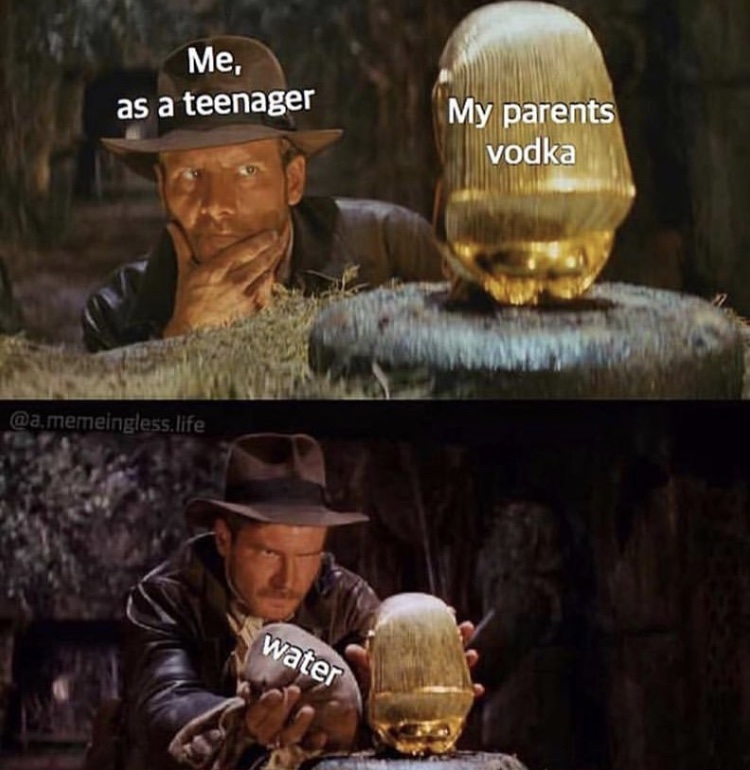
The picture above can double as a meme and an enthymeme. Its meaning is dependent on the understanding of the unstated premise between both the audience and the author. This meme in particular is pretty self-telling. The information given is that this is from Indiana Jones. We get the picture of the golden artifact, which is labeled as “parent’s vodka”, the look of Jones’s pondering face, labeled as “me as a teenager”, and we see the “dummy” artifact labeled as well, with “water.” The meme depicted is pretty clear since it is labeled and put together very well, but it is still dependent on the viewer’s cultural understanding of the scene and of the captions.

One must know the circumstances of this scene from Indiana Jones, but one must also have a shared set of experiences with the creator of this meme. If you have not tried to replace your parents’ liquor with water in high school, then it may be hard to relate and process the meaning of this meme. If you have tried this tedious and dangerous stunt as a teenager, you will know that it is a very similar process to what Indiana Jones is doing above. Its humor is embedded in the cultural understanding of the meme.

Citations

Jordan, Mark. “What’s in a Meme?” Richard Dawkins Foundation, http://www.richarddawkins.net/2014/02/whats-in-a-meme/.

Chandler, Curry. “Memes, Enthymemes, and the Reproduction of Ideology.” Curry Chandler, 14 Sept. 2015, currychandler.com/cool-medium/2015/9/14/memes-enthymemes-and-the-reproduction-of-ideology.

Finnegan, Cara A. “The Naturalistic Enthymeme and Visual Argument: Photographic Representation in the ‘Skull Controversy.’” Argumentation and Advocacy, vol. 37, no. 3, 2001, pp. 133–149., doi:10.1080/00028533.2001.11951665.

MBP #3

A visual enthymeme is defined as a syllogism with an absent premise that is supplied by the audience. There are two parts of a visual enthymeme: objectives and benefits. The objectives is the image itself and can be shown as proof that something is happening; Whereas the benefits are the force behind the image and meaning. Enthymeme’s rely on common world knowledge and they make sure that everyone can see the underlying meanings behind a message or image. The image that I used was from President Trump’s campaign “Make America Great Again.” The hidden premises in this message is that if you vote for Trump, America will be great again, and if you don’t vote for Trump America will be bad. The conclusion of this enthymeme is that by voting for Trump, America will be great again, which is hasn’t been for many years. Furthermore, we assume as a public that if this man is elected, things will be better again. Another hidden message is that it never says when America was ever great, everyone seemed to have a common knowledge of when America was actually “great” but never had a specific date or time. This campaign slogan was very effective because everyone wants to reminisce on the past and think about how great things use to be and imagine a better world.