Analytical Blog Post #6

Kaitlin Bryan

Professor Jamie Downing

Analytical Blog Post

30 April 2019

Culture Jamming according to Harold is, “a strategy of rhetorical protest”. In other words it is a form of rhetoric that disrupts the normalcy of how we know life and forces people to stop and think. This essay is going to take turtle and plastic straw video and an ad that has come about because of it. It will analyze its intent, effect and its effectiveness.

This paper will begin by discuss what occurs in the turtle and straw video. It is a video that has been seen by over 35 million people (youtube). It is a video of a turtle that is pain because there is a straw that has been stuck in its nose. There are people who work with the turtle until they can dislodge it. It is a very graphic video and difficult to watch, but leaves a lasting imprint on anyone who does watch the video. Now the image of the turtle that was posted by GreenPeace has the slogan, “Don’t suck the life from our oceans”. The image shows a turtle that is in the process of eating or choking on a straw. The turtle is in a cup of water and blends in with the typical bend of the straw. It is a very normal looking picture of a cup with a straw in it until you realize the turtle that is at the bottom of the straw. This is an example of culture jamming. It is an “interruption, a sabotage, hoax, prank,  banditry, or blockage of what are seen as the monolithic power structures governing cultural life” (Harold, 192). It appears to be a regular drinking cup, but a very obvious turtle eating a straw causes the audience to stop, stare and question.

The intent behind this image is to bring awareness to the effect that our plastic waste can have on animals. According to National Geographic, 500 million straws are used a day, and 8. 3 billion plastic straws have been said to pollute the world’s beaches. The intent that this video and ad have are to bring awareness to the amount of straws that we use. The UGA New Materials Institute found that 100% of turtles have eaten plastic, including baby turtles who have suffered and died as a result of ingesting plastic (strawlessocean.org). All this being said this ad produced by GreenPeace is wanting to bring awareness to this issue and reduce the amount of plastic going into the ocean. This form of verbal culture jamming is “the stopping of corporate media” (Harold, 192).

Next this paper will discuss the effect that this campaign has on the surrounding community. When the video of the turtle became popular, people began to advocate for getting rid of straws. Some of these people included various restaurants who banned straws from being served in their restaurant. According to National Geographic on January 1st 2019, the serving of plastic straws in restaurants and other businesses were banned starting in Washington D.C. Restaurants quickly hopped on board, such as, Starbucks, Mcdonalds, and Bon Appetit, a food service company with one thousand locations in the U.S. are all little by little wanting to completely get rid of using straws. As of now, they will not serve them, unless you ask. Alaska Airlines is one of the first airlines to come behind this campaign and not serve plastic (nationalgeographic).

This campaign has become rather effective, a slogan called, “Skip the straw” and caught footing (sailorforthesa). Advocating for the reduction of plastic straw use with the hope of one day fully abolishing any unnecessary use of them. There is of course the expectation of those few whose physical ailments have caused them to need straws to eat and drink. Slowly but surely getting rid of straws has become more apparent. July 11 is now classified as “Straw Free Day”. According to Eater, in the recent several months, many American cities and famous celebrities, including Tom Brady, have all come behind the ban-the-straw-movement. Starbucks hopes to abandon all use of straws by 2020. Now many people are using metal reusable straws (eater).

Culture Jamming is obviously a very effective means of advertising as can be seen by looking at the impact that the picture and video of the turtle and the straw have on society.


Work Cited:

Gibbens, Sarah. “A brief history of how plastic straws took over the world.” Plastic straw bans are spreading: Here’s how they took over the world. 03 Jan. 2019. National Geographic. 30 Apr. 2019 https://www.nationalgeographic.com/environment/2018/07/news-plastic-drinking-straw-history-ban/>.

“Why This Matters.” For A Strawless Ocean. 30 Apr. 2019 https://www.strawlessocean.org/faq.

“Skip a Straw – Save a Turtle.” Sailors for the Sea. 16 Mar. 2018. 30 Apr. 2019 http://www.sailorsforthesea.org/programs/ocean-watch/skip-straw-%E2%80%93-save-turtle>.

https://www.eater.com/2018/7/12/17555880/plastic-straws-environment-pollution-banned-alternatives-ocean-sea-turtle-viral-video


https://www.plasticpollutioncoalition.org/pft/2015/10/27/the-turtle-that-became-the-anti-plastic-straw-poster-child

https://www.youtube.com/watch?v=4wH878t78bw

Visual Analysis of Mule and Tenant Farmer Statue


I thought this mule statue was a very interesting thing to showcase. The Perry author obviously believes that the mule is significant to Georgia’s agriculture. He claimed that the men and mules who worked on the farms during the time of the civil war are responsible for much of the success of the South’s economy, especially in Georgia. The statue is bronze and a life-size representation of a mule plowing a field with a man and his son pushing the plow from behind. The view point of the man and boy is the mules rear which is what they would see for most of the day. This statue is a ” Reminder of an imperfect system and a “thank you to tenants who pulled the plows.” However, upon further visual analysis, this statue seems to celebrate the mule more than the man. It is all about the mules importance and how the agriculture and economy benefited, all the while seeming to drag the tenants through the mud, literally. it seemed to humiliate the people rather then honor them.

The Farmer also discusses his book that he wrote, “Tales From Georgia’s Gnat Line” which he says is about “The South he loved” which he goes on to say that it is honorable to highlight the differences among people and not make them all the same.” if he was arguing authenticity then maybe it would be a good argument, however, he was referring to the Civil War time period, so his statement could be taken as being racist.

I don’t think that the mule should be recognized at all as it only seems to put the people in a lesser light than even the mule. If they want to recognize the mules that one thing and they can by not putting people there. However, if they want to put both people and a mule in the image and only talk highly of the mule, it will is pretty degrading, to put it lightly. 


Mini Blog Post #6

This is a picture of an angel statue that is placed in the Cedar Lane Cemetery at Central State Hospital in Milledgeville. It marks the place where nearly 25,000 souls are now claimed to be buried.  2000 grave markers had been misplaced over the years and the angel, located 175 yards south of here, stands as a constant guardian. Former workers as well as patients fought to erect this statue. Under the angel they placed a time capsule and a CD recording of all those who had died and were buried in the cemetery.
I believe that this statue reminds people of the loves that were lost and offers comfort to those whose graves are now unmarked. Although the graves stones may be gone, their names never will be. The angel is gazing into Heaven, one arm outstretched, the other reach with his hand open to the earth beneath him. It appears that He is stands as one who will bring the dead to Heaven. He appears to be a sort of savior figure.
The angel is in the midst of the cemetery, open to the eyes of the public, and yet, it appears the angel demands a sort of reverence that should be made toward him and the situation. Only the angel appears to be allowed to remain amidst the Garden. It is not something to be tampered with, but instead, acknowledged. It reminds people of the lives lived in the Insane Asylum and creates a platform for people to be able to come and remember and honor the dead. This angel reminds people that even though the graves may be gone, their legacy and names will not be lost. In the words of Dickinson, “It creates spaces in which rhetors and audiences can ‘feel more at home with others and our surroundings’ “(215). Having architecture such as this angel brings something to the cemetery that a mere sign could not. It represents an ideology. It brings people together to remember the lost while being ethical and honorable to the environment that is around it.
work cited:

mini blog post #5

Image result for flash mobs

An example of culture jamming in a flash mob. Harold describes culture jamming as “a word in which one disrupt existing transmissions. It usually implies an interruption, sabotage, hoax, prank etc.” (92). A flash mob is a group that gathers together in public in an effort to entertain for a brief time. It is never something that people expect, but just shows up in a public area. Before a flash mob comes up people may be enjoying a meal or simply walking about enjoying their daily life. Then the flash mob will begin, taking people by surprise and causing everyone around to stop what they are doing and watch. They have different intentions for performing this and sometimes it is solely for entertainment, sometimes it is for a surprise engagement and other times to get a message across to the audience. They take advantage of the power they have to entertain and disrupt normal activity with a strange organized flash mob.

Analytic Blog #3

VR4VR 2VR7VR6VR8VR3

The social group that I chose to use for a more descriptive narrative was Milledgeville’s very own Blackbird Coffee house. I will use these images above to do a narrative analysis using Bossen and Freedman as a model.

These images were taken from Blackbird’s Facebook page which I believe showcases the organization well as a whole. In Bossen and Freedman’s article, Dusseault’s photograph of the landscape “enables the viewer to understand change over time and the remaking of one type of space into another (79). The images are strategically placed starting with the outside of the coffee shop and moving its way through the cafe. College students pass by this window with “Coffee, Roastery, and Cafe” on it everyday on their way to class, and it would not be fair to leave it at that. When you go inside, you see where the magic happens. From the view point of the baristas we see Espresso into a mug and the register to take the order of the next person who walks into the door. The next image is of a coffee mug which is a common site all over campus, as students and professors alike will take a coffee break and head to blackbird to get coffee. Students enjoy this local cafe which also offers merchandise which is seen at the end of my visual narrative. Not only do customers enjojy the coffee they provide, but they also show their increased love for Blackbird through purchasing and wearing their merchandise.

This photos present themselves on Facebook as informative, welcoming, enjoyable, and progressive. They inform you on what the organization is all about and their vision behind opening it. By showing the entrance of the building they welcome you in, showing you the experience to be had on the inside. They progress as they show different aspects of the store and the journey to be had while inside, from entering the building, to purchasing coffee, to enjoying coffee, to enjoying the scenery, to investing in their merchandise.

As Bossen and Freedman discuss the methods used in photography, Molten Light was something I saw represented here. In order for an image to be considered Molten Light “a photograph must sit at the intersection of art and industry and must move beyond pure documentation to reveal interpretative aspirations of the image maker (78). The images of Blackbird not only document their story of blackbird, also show forth their vision behind it. A friendly, social environment where people from all backgrounds can come gather and enjoy one another’s company. The photographs desire to draw people in to see the same interpretation.  As we look to the physical aspect of this pictures, it is important to also recognize the deeper internal meaning being portrayed. the literal analysis see in the Blackbird visual conveys bright imagery with similar colors throughout the pictures. We also see the logo of a black hand drawn bird, hence Blackbird. When we begin to look more at the deeper meaning of these images, we see the pathos going on here. A girl is enjoying the gift of fellowship, as well as, life. It is not just the coffee, merchandise and store that makes Blackbird good, although they are. It is the fellowship had, the relationships nurtured, the productivity and ideas discussed and put into action, and the joyful experiences had overall. It is the ambiance of it all the really draws people in to the visual of it all. The evoke a sense of wanting to accomplish something and make a difference in this world.


Visual Narrative

This visual narrative will take you on a journey through the Georgia College radio station, WGUR The Noise on 95.3 FM radio. It is a station that has a wide variety of talk shows and music. The eight photos are put in a specific order that will walk you through a day-in-the-life of a DJ Host for WGUR. The first image is right outside of our studio, indicating what and where our studio is. It is the first thing you see before walking into the studio. The second picture is the first room you see when you walk in and is also where “Couch Concerts” are recorded. The next picture leads you into the studio where me and my friend Sam have our show. The computer is where you choose what music you want to play and the dials are used to control the volume for the mics and the music. The close up of the mic is your point of view when you on air and the last image is from the opposite perspective, looking in on you. Lastly, my visual narrative closes with “on the air” sign to encourage  you to tune in when we are on the air next!

IMG_4588IMG_4584.jpgIMG_4575

IMG_4580

IMG_4593.jpgIMG_4594.jpgIMG_4585IMG_4582


Mini Blog Post #4


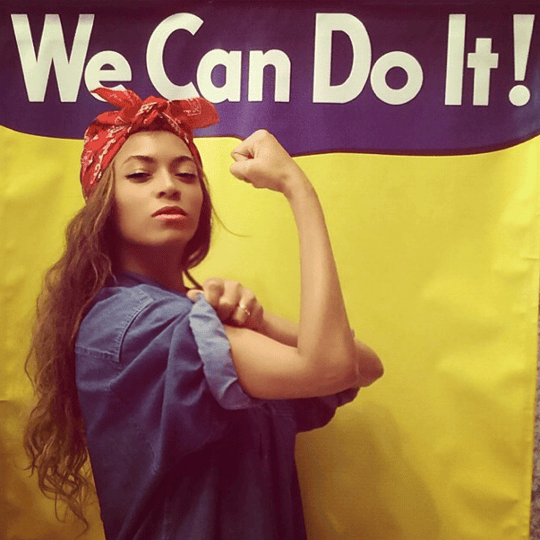
Edwards and Winkler defines an ideograph as a concept “culturally grounded, summarizing and authoritative terms that enact their meaning by expressing an association of cultural ideals…within the rhetorical environment.” This image is a picture of Beyonce imitating Rosie the Riveter in an effort to bring awareness to woman empowerment. The ideograph that I will focus on in this image is empowerment and feminism. This image goes to show that woman are fully capable of taking care of themselves and have the right to be heard. She is a model for woman, answering the question, “Who Runs the World?” GIRLS! This image portrays strength to a culture where woman are often seen as lesser than. Beyonce is flexing her arm like Rosie in order to show her power. Rosie the Riveter was bringing awareness to the woman in World War II who worked hard in factories. This image in today’s culture also is seen as an means to bring empowerment to women and show their strength and rights to work. Visual ideographs can elicit various responses, but will most often leave an impact on the viewer.

Analytic Blog Post #2

famous photo by Kevin Carter showing a small African child starving while a vulture waits behindA naturalistic enthymeme is the assumption that photos present reality and an enthymeme is when one premise remains unstated. According to Finnegan, a naturalistic enthymeme is when, “we assume photographs to be ‘true’ or ‘real’ until we are given reason to doubt them (Finnegan 135).

Below is an image from digitalphotomentor.com that was taken by Kevin Carter and titled the “Starving Child and Vulture”.  This photo caused a lot of controversy because of how heart wrenching the image is. In this image we see a starving little girl and a vulture lurking in the background, staring directly as her. The first premise in this photo is that this photo represents reality. The second is that this photo is of a starving girl with a creeping vulture in the background. In conclusion,this girl is in real danger of being attacked by this vulture. Now, this conclusion is the premise that has been omitted and been left to the audience’s assumption based off of his or her’s viewing of the photo. They believe this photo to be a reality, thus they have created an enthymeme.

Because of the publicity that this photo received and the belief in this naturalistic enthymeme, people were outraged at the photographer. They were frustrated because it appears that the photographer is watching as a little girl is in danger of her life, both from the vulture as well as from starvation (Digital Photo Mentor). The consequences of this photo is that without knowing the full context, the onlooker will automatically assume this to be true. Due to all the stress and hate from the public, Kevin Carter ended up taking his life in 1994, one year after the picture was released. These were the negative consequences from this photo, but some of the positives that resulted from this picture was the awareness to world hunger that it brought. Hearing about world hunger is one thing, but seeing it with one’s own eyes is a complete other aspect. Seeing the utter helplessness of this child and how her life is on the line caused people to jump to action. It also made people think of what is ethical when taking pictures and what is not. Having the photographer alter the picture in such a way to make it stand out more resulted in major consequences that may or may not have occurred if he had done things differently (Digital Photo Mentor). If the viewer knew the truth, they may not have been so quick to judge the photographer, or feel the immediacy and urge to help. What this photo does not show is the mother standing off to the side out of view of the camera shot. The photo also had a special lens to make the bird look closer than it really was. Knowing these two truths would not have caused the onlooker to be so emotional and heart wrenched. This image is quite similar to the skull controversy explained by Finnegan, Lewis and Farid. The skull controversy wanted to raise awareness to the drought in the land and manipulated the image just like Kevin Carter did here, in order to make the situation to appear more severe than it actually was. The skull controversy caused the viewer to take what they saw and believe it to be a reality. According to Finnegan, “Participants in the skull controversy, particularly those who attacked the skull pictures as ‘fakes’, grounded their arguments in the naturalistic enthymeme” (136). The photo of the child was similar to the skull controversy in the way that it caused people to assume things about the photo while not having the full picture. Both were, in a sense, deceived because of the thwarting of the image that took place. Lewis furthered this truth by saying that, “we should judge a photograph as a collection of purposed facts about the world that is accurate if claims are true and inaccurate if they’re not” (Lewis, 3). In other words, people should be skeptical of what images they see as it may not be completely true. Images can be easily tampered with to create various meanings and results. In conclusion, it is clear how images can have different meanings and consequences by the way they are presented to the public.

Work Cited:

https://www.digitalphotomentor.com/20-most-famous-photographs/

file:///home/chronos/u-3ac062d9a03d410019e04c597f2009fa664a3ea0/Downloads/Finnegan–The%20Naturalistic%20Enthymeme.pdf

file:///home/chronos/u-3ac062d9a03d410019e04c597f2009fa664a3ea0/Downloads/Lewis–Don%E2%80%99t%20Believe%20What%20You%20See%20in%20the%20Papers.pdf

MBP #3


Child Attends Funeral Of His Dad


An enthymeme assumes the premise that the image is essentially natural and has now been provided by the audience. Finnegan says the visual arguments are identified as demonstrative and rhetorical. Images work to convey a message to the audience, often using things such as enthymemes. It is when an image is natural, and not staged, that it has a great impact on the audience. An example of this can be seen the picture above. There a few things in this picture that are factual, that can be known. On the other hand, there are things in this image that are implied. The first premise that can be clearly seen in this picture is that a soldier of the U.S. Military is giving a folded up flag to a boy. He is dressed in his full military attire and giving a flag to a boy dressed in all black. He is also kneeling down, which is a sign of respect, while he gives a flag to an emotional boy. The second premise is that this image was taken at the moment is occurred in order to document the moment. This can be believed to be true until proven otherwise according to Finnegan (135). The third premise is that the picture was not staged, but is authentic. This image is realistic due to the careful analysis of the things we know to be true and consistent. Through looking at the context and cultural norms of this picture, it can be stated that this is a naturalistic enthemyme, and not thwarted by any outside force. Finnegan claims that the visual argument is reliant on visual culture because it enables an image to have context to support a natural enthymeme. 

Analytical Blog #1

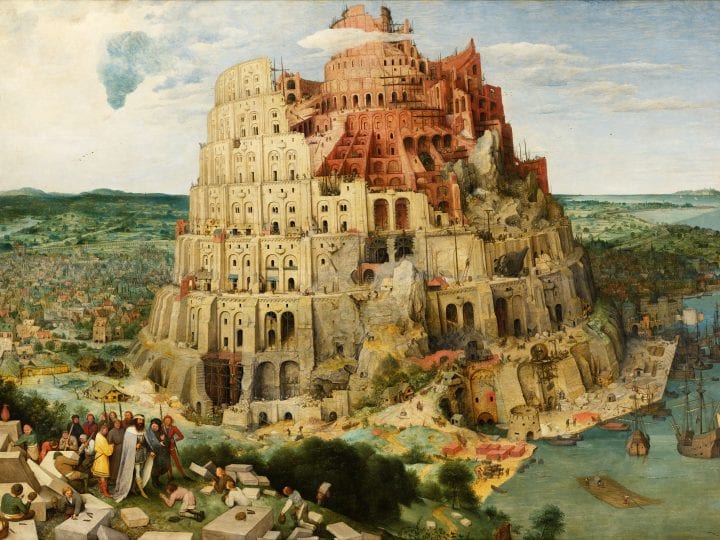
Pieter Bruegel the Elder,  The Tower of Babel, 1563, Kunsthistorisches Museum, Gemäldegalerie, Vienna

Pieter’s Bruegel’s Tower of Babel, 1563, is an oil on panel that represents the Biblical story of the Tower of Babel (Kaminska). Religious individuals may be familiar with this story, but for those who are not, this article will go into depth while analyzing this painting. Whether or not you know the story of the Tower of Babel or not, there is still so much to learn about this picture. We will also look at authors who will aid to our overall analysis.

The striking size of the tower is the first thing we see when we look at this painting. From afar, the structure of the tower looks impressive and grand, but when you take a closer look, the truth begins to unfold, and the details give you a deeper understanding of the situation. In Genesis 11:4 the people cried, “Come, let us make a city and a tower.” We see scaffolding set up all around the tower and people laboring while ships bring in supplies in the port in the harbor right of a picture. According to H. Arthur Klein, the painting is depicted as being “huge but incomplete” (Klein, 134). In the bottom left corner we see King Nimrod and his men standing confidently, as people in the background are building a tower in an effort to reach Heaven. The people are building a seemingly magnificent tower that can be see at a quick glance from afar. We see a beautiful landscape behind the tower, a calm ocean front, and a very elaborate tower. The hue is a mixture of earth tones such as greens, blues, yellows and a pastel red. The value in the picture is high and draws us into the tower of the vocal point. The small people and the horizon line in the background help give perspective of just how large the tower is. In regards to the meaning of the painting, The Kunsthistorisches Museum, referred to it being “an artistic gesture…enhancing the impression of the building’s monumentality, and on the other hand alluding to human hubris and the impossibility of completing the tower because ‘the Lord confused the language of all the earth’.” In other words, pride comes before a fall. The men thought they could work their way to God, creating an impressive structure, but on a unstable foundation. The Lord confusing the language was the means he used to make it “fall”. S.A. Mansbach, who has a similar interpretations says the tower is, “an example of pride punished.” It was the work of the men and the intentions of their hearts that made the Lord punish them. Joanne Morra argues the tower, “exhibits an incompletion, the impossibility of finishing of totalizing, of saturating, of completing something on the order of edition, architectural construction, system and architectonics.” In other words the Tower of Babel symbolizes one’s moral compass never being able to reach completion while on earth. A person that is trying to attain perfection on it’s own will never make it without divine help may be another meaning behind this painting. The fact that this tower is slanted and on unstable ground gives insight into the lives of those building it. Their mindset is “slanted” by the fact that they think they can build their way up to God, and their “unstable foundation” is resting on their own will power to attain oneness with God. The painting goes deep in theology and understanding man’s desire for power and control. A painting at first glance the appearance of a picture can be deceiving, but upon further inspection, one can dig deep and find a truer and richer meaning behind it. Sturken and Cartwright in their book, “Images, Power, and Politics”, say, “A single image can serve a multitude of purposes I, appear in a range of settings and mean different things to different people”. This is true for “The Tower of Babel” which means multiple things to multiple people. It does have an underlying meaning, however, which is that there is something being destroyed because man’s selfish motives are preventing from people being able to be a team and build a tower together. We see the importance of analyzing a painting, as our perspectives can completely change from the first and second time we look at the piece of art.

Work Cited:

Barbara A. Kaminska, ““Come, let us make a city and a tower”: Pieter Bruegel the Elder’s Tower of Babel and the Creation of a Harmonious Community in Antwerp,” Journal of Historians of Netherlandish Art 6:2 (Summer 2014) DOI: 10.5092/jhna.2014.6.2.3

Jacques Derrida, ‘Des Tours de Babel’, in Difference in Translation, ed., trans., and notes Joseph F. Graham, Ithaca and New York, 1985, 165–207.

Klein, Arthur H., “Pieter Bruegel the Elder as a Guide to 16th-Century Technology”. Scientific American , Vol. 238, No. 3 (March 1978), pp. 134-141. https://www.jstor.org/stable/pdf/24955665.pdf?casa_token=zZB2JN1paQUAAAAA:j