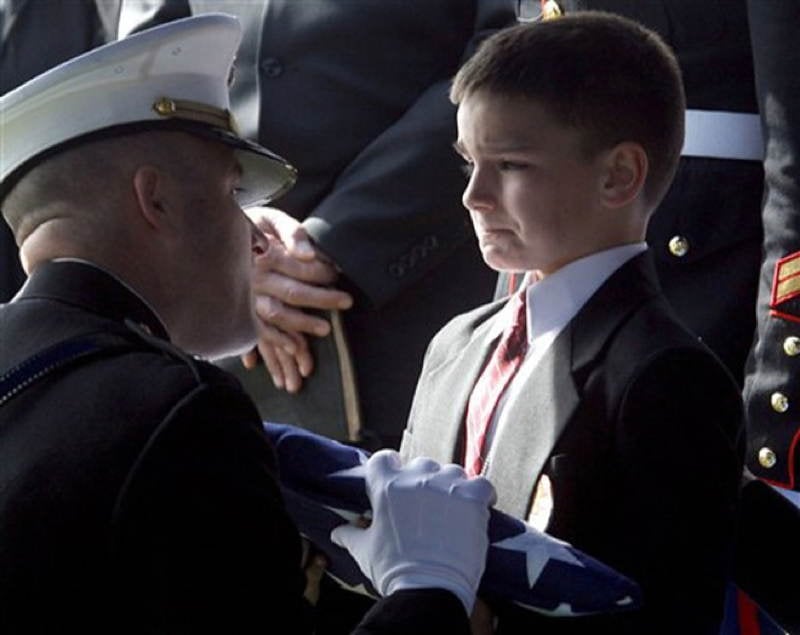
An enthymeme assumes the premise that the image is essentially natural and has now been provided by the audience. Finnegan says the visual arguments are identified as demonstrative and rhetorical. Images work to convey a message to the audience, often using things such as enthymemes. It is when an image is natural, and not staged, that it has a great impact on the audience. An example of this can be seen the picture above. There a few things in this picture that are factual, that can be known. On the other hand, there are things in this image that are implied. The first premise that can be clearly seen in this picture is that a soldier of the U.S. Military is giving a folded up flag to a boy. He is dressed in his full military attire and giving a flag to a boy dressed in all black. He is also kneeling down, which is a sign of respect, while he gives a flag to an emotional boy. The second premise is that this image was taken at the moment is occurred in order to document the moment. This can be believed to be true until proven otherwise according to Finnegan (135). The third premise is that the picture was not staged, but is authentic. This image is realistic due to the careful analysis of the things we know to be true and consistent. Through looking at the context and cultural norms of this picture, it can be stated that this is a naturalistic enthemyme, and not thwarted by any outside force. Finnegan claims that the visual argument is reliant on visual culture because it enables an image to have context to support a natural enthymeme.

 Thinking Rhetorically at GCSU