Memes as examples of enthymematic reasoning:
Memes are a staple of today’s internet. “Meme” originally was a term coined by Richard Dawkins in his book “The Selfish Gene.” Dawkins believed ideas, notions, and behaviors were influenced through evolutionary methods. Dawkins believed that if a shared behavior or notion was popular enough in a successful community, then it would show to have positive effects on gene survival. Dawkins claimed memes needed to be replicated and reproduced through populations. The internet “meme” has spearheaded the meaning of “meme.” Dawkins’ term for meme and the modern internet meme are not far off from each other.
A strong case could be made that religion is a meme embedded within our culture. Certain religious beliefs have positive effects on societies, which is why these rites have been successfully passed down for so many generations. If religion has survived this far, there is a biological and evolutionary reason for its constant existence.
Today’s definition of “meme” is a viral, easily-replicable, shared set of experiences that invoke laughter, emotion, or humor. Memes become viral and are predicated by a shared understanding of certain behaviors or cultural beliefs.
An enthymeme is a syllogism in which a premise is left out of the argument. It is important that the left out premise is understood by the audience. The shared understanding of this missing premise between the creator and viewer, and the shared understanding between the viewer and other viewers is critical for the popularity and viralness of the modern day “meme.”
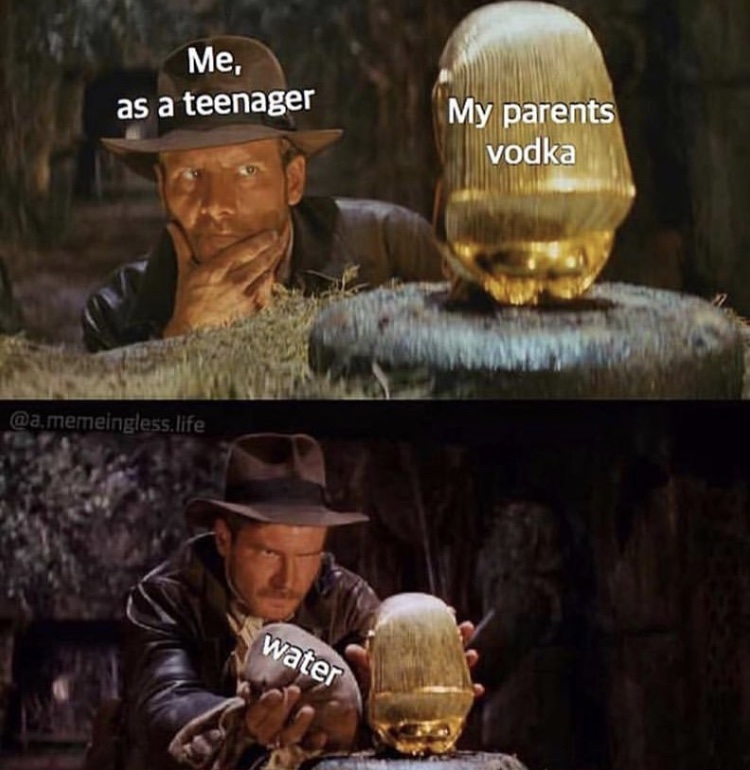
The picture above can double as a meme and an enthymeme. Its meaning is dependent on the understanding of the unstated premise between both the audience and the author. This meme in particular is pretty self-telling. The information given is that this is from Indiana Jones. We get the picture of the golden artifact, which is labeled as “parent’s vodka”, the look of Jones’s pondering face, labeled as “me as a teenager”, and we see the “dummy” artifact labeled as well, with “water.” The meme depicted is pretty clear since it is labeled and put together very well, but it is still dependent on the viewer’s cultural understanding of the scene and of the captions.
One must know the circumstances of this scene from Indiana Jones, but one must also have a shared set of experiences with the creator of this meme. If you have not tried to replace your parents’ liquor with water in high school, then it may be hard to relate and process the meaning of this meme. If you have tried this tedious and dangerous stunt as a teenager, you will know that it is a very similar process to what Indiana Jones is doing above. Its humor is embedded in the cultural understanding of the meme.
Citations
Jordan, Mark. “What’s in a Meme?” Richard Dawkins Foundation, http://www.richarddawkins.net/2014/02/whats-in-a-meme/.
Chandler, Curry. “Memes, Enthymemes, and the Reproduction of Ideology.” Curry Chandler, 14 Sept. 2015, currychandler.com/cool-medium/2015/9/14/memes-enthymemes-and-the-reproduction-of-ideology.
Finnegan, Cara A. “The Naturalistic Enthymeme and Visual Argument: Photographic Representation in the ‘Skull Controversy.’” Argumentation and Advocacy, vol. 37, no. 3, 2001, pp. 133–149., doi:10.1080/00028533.2001.11951665.

 Thinking Rhetorically at GCSU