Analytic Post 1


In honor of the Super Bowl this weekend, I thought it would be an interesting time to consider the image behind a national controversy surrounding American football and politics: Colin Kaepernick kneeling during the National Anthem before competing in NFL games.
This subject is one that, as Americans, we have, at the very least, heard of and talked about to some extent in the past year. We have heard the battle between political parties and their beliefs about it, accusations of being unpatriotic, and the voices of the Black Lives Matter movement. But we don’t often discuss what is actually the core of unrest when it comes to the act of kneeling vs. standing during the National Anthem. Using the concepts that we have discussed in class so far this semester, rather than merely discussing the politics of the matter, I’ve decided to rhetorically analyze this image with attention to the implications of kneeling vs. standing as a sign, and consideration for how the technological and social modalities influenced its reception.
 
First, I think it is important to think about the traditional social implications of kneeling. In many cases kneeling, or “taking a knee,” is seen as a sign of respect and devotion. For example: kneeling in the presence of royalty, athletes “taking a knee” on the soccer field when another player is injured, or a man getting down on one knee while proposing. Typically when we see the gesture of kneeling, we do not associate it with protest or anger. The image of someone kneeling being positive or respectful has developed from cultural norms and expectations over time. When we see a man and a woman together and the man gets down on a knee, we can assume what is going to happen because that gesture signifies a proposal in our brains. Kneeling is a sign to us. Think about this: Would it be odd to if your significant other did not get down on one knee when proposing? Would that be right or wrong? On the flip side, would you consider proposing to someone without committing this gesture? Or is that already something you would do without conscious thought?
My point is that the cultural expectations that can come with certain signs, even things as simple as the body’s physical positioning during specific cultural situations, is incredibly important to the people within that culture. If the expected behavior is not carried out, it can cause significant confusion or concern.

Likewise, during the playing of the National Anthem, it is expected that Americans stand. The act of standing is meant to signify respect and honor to the American flag, the military, and the country. Therefore, the juxtaposition of a traditionally respectful body posture (kneeling) during a time when there is a cultural/social expectation for standing confuses the viewers. They do not seem to go together. The sound of the National Anthem is a signifier for people to stand to signify their respect. Choosing not to do this is choosing to go against an agreed upon social expectation, and with that comes the confusion. Is Kaepernick being disrespectful of the American flag or displaying ignorance? Is he trying to signify respect for something else by kneeling?
 
Even without any political context, when people watch an NFL match over television or while they are standing in a stadium, whether or not they are consciously aware that they are looking for it, they will notice when someone is doing something that disrupts their expectation. With this in mind, it is clear that Kaepernick knew he would be seen when he made the choice to begin kneeling rather than standing during the National Anthem before games. He has taken advantage of his access to the modality of the media and widespread communication to illustrate his message. By doing so he directs attention to himself and displays an image of himself that illustrates his lack of approval for something that he believes the National Anthem or the flag might symbolize to him or the American people. This image makes people think. It is not the words that he is saying, but rather the image that he is displaying, and it’s incongruence to cultural expectation that causes unrest and implies his message.

-Sarah Bergin 02/03/19

Analytic Blog Post #1

Images are created and represented in a variety of ways. Images can be sketched, drawn, painted, photographed and so much more. The difference among all of these representations, however, is how audiences respond. When images are more realistic, the audience cannot picture themselves as much per say, in that exact situation or see it as relatable, but the image can still jar us emotionally and cause us to be sympathetic. When images are more iconic, or represent “a person, place thing or idea” (McCloud 4), the audience relates to the character more on a personal level because they can easily picture themselves in the situation.

Our world is surrounded with different types of images, particularly iconic ones. Icons are seen in everyday advertisements, cartoons and more. With cartoons in particular, we universally identify with those images, especially if they are more simplistic. The cartoon acts as “a vacuum into which our identity and awareness are pulled… we don’t just observe the cartoon, we become it.” This explains why when children watch a cartoon, why they become so entranced with the show itself and the material; they see themselves in the character and can identify with the characters in those situations. This can particularly be seen with the masking effect (McCloud 22), where more detailed backgrounds are utilized with more simplistic characters, causing us to be able to mentally place ourselves in that situation even more. When we see cartoon and iconic images, whether children or adults, we relate and respond to them on a personal level. It causes us to think about how we would respond to whatever problem the character is dealing with, and really pulls us into the cartoon and out of the real world.

When the images are realistic, however, we are more likely to react with sympathy (depending on the image) and feel more firmly rooted in the real world. Images of catastrophes are used around the world everyday to show people the level of real devastation that occurs during these events. Mahoney describes just how his sketches were used to show the general public how badly the Irish potato famine affected communities: “the visual sketch confirmed the authenticity of famine suffering, serving as an eyewitness representation of a moment amidst the calamity” (Farrell 10). One more modern instance of using realistic images to show the calamity of an event would be with Hurricane Katrina. I have provided a sample image that shows just how catastrophic Hurricane Katrina was and how much damage it had on New Orleans. When images like these show up in newspapers, it really jars people with the seriousness of the events. These pictures show just how detrimental of an effect these catastrophes have on different communities. Because the pictures are so jarring, they cause people to sympathize with the parties pictured. However, because the images are realistic and not iconic, it does not allow audiences to personally identify with the people as much. They do not picture themselves in the situation that the image captures, but instead, the shock of the chaos shown in the image brings people back to reality. The shock causes the audience to clearly be able to see that they are in their reality, not in the image and that they cannot personally identify with the plight of the people in the image. While people feel sorrow and sympathy for the people dealing with the situation at hand, the lack of identification allows the majority of audiences to not feel a sense of responsibility or feel like they are obligated to do something. In other words, realistic images cause sympathy, but also create a sense of otherness and isolation from the image, whereas with icons and simplistic images, we relate to them on a deeply personal level.

Analytic Blog Post #1

130325222520-pmt-christine-brennan-tiger-woods-nike-ad-00010029-story-top

In recent years, Nike has become increasingly more bold in their marketing strategies, particularly when it comes to the athletes they select for their advertisements. While the famous motto “Just do it” has remained the same, the way in which Nike chooses to execute this theme has become more and more daring. With these new, envelope-pushing perspectives come various perceptions of meaning from the audience. Two examples of recent controversial Nike ads are that of Tiger Woods and Colin Kaepernick. This post will analyze these types of ads as well as the audience’s different reactions to them. 

First, for length purposes let us focus on the older of the two ads, Tiger Woods. This ad shows Woods kneeled down watching his ball travel towards the hole. The look on his face is one of passion, hope, and anxiety as to how his putt will turn out. The environment of the image is sunny and green creating a pleasant background for a round of golf. Displayed across the image are the words “Winning takes care of everything”, a quote that Tiger Woods himself provided. And finally, in the bottom right-hand corner is the word “victory” with the iconic Nike swoosh next to it. In all, a very aesthetically pleasing and inspiring advertisement. However, though the ad seems clear-cut it actually creates a slippery slope of different meanings for the audience. 

There are many different ways a viewer could interpret this message from Nike. The direct interpretation, or “dominant reading” is simple: Tiger Woods, the number one golf player in the world, wears Nike, so in turn if you wear Nike, you could be a winner. Another dominant reading could be that only the best wear Nike, so if you consider yourself the best or want to be the best, Nike is the only choice. Of course the purpose of any ad is to convince a consumer to buy a product, but the way in which Nike chooses to do this is by telling the consumer a story; a story of success, a story of “victory”, a story that could easily be your story, too.

However, while the dominant reading of this ad is that Nike makes you a winner, the audience can also take away a lot of other “readings” from this “story”; readings that Nike marketers likely didn’t intend to convey. These readings are called “aberrant” readings. For example, this ad took a lot of heat because consumers felt that it was making light of Woods’ controversial marital history. In 2009, Woods admitted to infidelity and apologized to his sponsors and fans. This infidelity ultimately led to the end of his marriage. This information regarding Woods’ personal life is so widely known it is practically common knowledge, at least to most everyone that follows news reports even semi-regularly. With this information in mind, an audience member could see this Nike ad (released well after Woods’ marital scandal) and perceive that Nike is making light of his moral indiscretion, which does not portray Nike in the most positive light. Nike claims that this ad had nothing to do with Woods’ personal life, but this does not keep the audience from believing whatever they please about this choice in advertising. 

Examples like this can be seen from many different companies advertising a host of different things. Nike is an easy company to point the finger at with their use of Woods and more recently Colin Kaepernick in their marketing, but companies like Carl’s Jr., Pepsi, and Starbucks have come under fire for their bold advertising techniques. While these techniques ultimately prove effective for the companies (Nike’s sales greatly increased after the Kaepernick ad in particular), they each take a risk in how their audience will perceive their messages. Each image has a unique rhetoric surrounding it and the way in which we read them, whether dominantly or aberrantly, can greatly impact the effectivity of a company’s choice in images. 

Analytic Blog Post 1

The digital age that we currently live in is filled with types of technologies that generations prior could have never dreamed of. From the more modest living room television to the advanced smartphones that deliver information to your fingertips, the degree to which information is readily available is greater than it has ever been in prior history. The important thing to consider during all these technological advancements and achievements is whether things have gone too far. Is it possible that with the influx of technology, people are decreasing their self-awareness and falling deeper into simplicity? In “Amusing Ourselves to death” Postman makes the argument that, due to the inherent biases of television in America, the populous is on the road to a Huxleyan dystopia where the populous cares less about the world around them than the fleeting pleasure they can be find in entertainment (Postman 98). In this blog post, we will discuss the validity of Postman’s observation as well as whether it is relevant to the year 2019.

According to Postman, television, as a type of technological medium, has inherent biases that keeps it from being completely neutral (Postman 84). The major difference between a technology and a medium is like the difference between the mind and the brain, the brain is the physical organ that does the work whereas the wandering mind is the resulting consequence of brain doing its work (Postman 84). Similarly, the technology is the machine that accepts inputs that lead to outputs that eventually create a unique culture of key words and phrases and standards of acceptable behavior. As for the bias of television, Postman said, “[television] has made entertainment itself the natural format for the representation of all experience (Postman 87).” This is problematic because entertainment, as a form of communication, is incapable of handling every type of situation. The point of entertainment is not only to make things simple and understandable to a basic audience, but also to frame topics and events in a way that makes them exciting and enjoyable to the viewer. Many topics are too complex to be simplified in this manner; therefore, making entertainment the purpose of everything makes mass misinformation far more likely.

To illustrate this idea, Postman reminds the reader of an ABC program hosted by Ted Koppel. During this program, multiple different guests and experts had a five-minute window to offer their commentary on nuclear war and foreign relations in response to the controversial film The Day After. Postman argued that although Koppel framed the program as a “discussion”, none of the guests interacted with each other in a meaningful enough way to merit the description of “discussion” (Postman 90). This program like many others emphasized the nature of the medium of television, each person has their five minutes of fame where they can say whatever they want to get recognition from a large audience. However, due to the entertainment-based culture of television, these people must present their information in a way that is entertaining; therefore, nobody would waste their precious five minutes responding to another person’s ideas, rather they would make the best use of their time. Because of this, no dialogue is taking place, no debate is happening, and no minds are being changed.

While Postman may be correct in the 80s when he claimed that “how television stages the world becomes the model for how the world is properly staged”, now with the advent of new technologies such as the internet and social media, the media that stages the world is far more advanced. No one can argue that our interactions on social media do not define how we view and process the world; however, the access to information is much more in the hands of the viewer than ever before. Speakers have far more than a five-minute time slot to get their ideas across. People are generally more culturally and globally aware. However, due to fake news and clickbait advertisements, it’s hard to say that Postman’s predictions of a Huxleyan dystopian will not entirely come true.

Postman, Neil. Amusing ourselves to death: public discourse in the age of showbusiness.

Methuen, 2007.

Analytical Blog #1

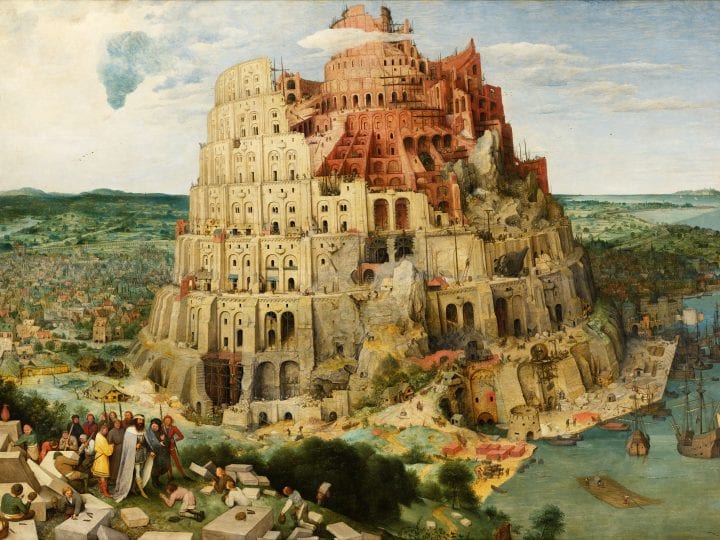
Pieter Bruegel the Elder,  The Tower of Babel, 1563, Kunsthistorisches Museum, Gemäldegalerie, Vienna

Pieter’s Bruegel’s Tower of Babel, 1563, is an oil on panel that represents the Biblical story of the Tower of Babel (Kaminska). Religious individuals may be familiar with this story, but for those who are not, this article will go into depth while analyzing this painting. Whether or not you know the story of the Tower of Babel or not, there is still so much to learn about this picture. We will also look at authors who will aid to our overall analysis.

The striking size of the tower is the first thing we see when we look at this painting. From afar, the structure of the tower looks impressive and grand, but when you take a closer look, the truth begins to unfold, and the details give you a deeper understanding of the situation. In Genesis 11:4 the people cried, “Come, let us make a city and a tower.” We see scaffolding set up all around the tower and people laboring while ships bring in supplies in the port in the harbor right of a picture. According to H. Arthur Klein, the painting is depicted as being “huge but incomplete” (Klein, 134). In the bottom left corner we see King Nimrod and his men standing confidently, as people in the background are building a tower in an effort to reach Heaven. The people are building a seemingly magnificent tower that can be see at a quick glance from afar. We see a beautiful landscape behind the tower, a calm ocean front, and a very elaborate tower. The hue is a mixture of earth tones such as greens, blues, yellows and a pastel red. The value in the picture is high and draws us into the tower of the vocal point. The small people and the horizon line in the background help give perspective of just how large the tower is. In regards to the meaning of the painting, The Kunsthistorisches Museum, referred to it being “an artistic gesture…enhancing the impression of the building’s monumentality, and on the other hand alluding to human hubris and the impossibility of completing the tower because ‘the Lord confused the language of all the earth’.” In other words, pride comes before a fall. The men thought they could work their way to God, creating an impressive structure, but on a unstable foundation. The Lord confusing the language was the means he used to make it “fall”. S.A. Mansbach, who has a similar interpretations says the tower is, “an example of pride punished.” It was the work of the men and the intentions of their hearts that made the Lord punish them. Joanne Morra argues the tower, “exhibits an incompletion, the impossibility of finishing of totalizing, of saturating, of completing something on the order of edition, architectural construction, system and architectonics.” In other words the Tower of Babel symbolizes one’s moral compass never being able to reach completion while on earth. A person that is trying to attain perfection on it’s own will never make it without divine help may be another meaning behind this painting. The fact that this tower is slanted and on unstable ground gives insight into the lives of those building it. Their mindset is “slanted” by the fact that they think they can build their way up to God, and their “unstable foundation” is resting on their own will power to attain oneness with God. The painting goes deep in theology and understanding man’s desire for power and control. A painting at first glance the appearance of a picture can be deceiving, but upon further inspection, one can dig deep and find a truer and richer meaning behind it. Sturken and Cartwright in their book, “Images, Power, and Politics”, say, “A single image can serve a multitude of purposes I, appear in a range of settings and mean different things to different people”. This is true for “The Tower of Babel” which means multiple things to multiple people. It does have an underlying meaning, however, which is that there is something being destroyed because man’s selfish motives are preventing from people being able to be a team and build a tower together. We see the importance of analyzing a painting, as our perspectives can completely change from the first and second time we look at the piece of art.

Work Cited:

Barbara A. Kaminska, ““Come, let us make a city and a tower”: Pieter Bruegel the Elder’s Tower of Babel and the Creation of a Harmonious Community in Antwerp,” Journal of Historians of Netherlandish Art 6:2 (Summer 2014) DOI: 10.5092/jhna.2014.6.2.3

Jacques Derrida, ‘Des Tours de Babel’, in Difference in Translation, ed., trans., and notes Joseph F. Graham, Ithaca and New York, 1985, 165–207.

Klein, Arthur H., “Pieter Bruegel the Elder as a Guide to 16th-Century Technology”. Scientific American , Vol. 238, No. 3 (March 1978), pp. 134-141. https://www.jstor.org/stable/pdf/24955665.pdf?casa_token=zZB2JN1paQUAAAAA:j


Analytic Blog 1

The new Diet Coke campaign “because I can”,  is a great example of an advertisement can be looked at in different ways to get a deeper reading. Upon first glance, this ad is seemingly straight forward: new Diet Coke cans and the phrase “because I can”, however, there are layers lurking under this topical reading that requires unpacking in order to understand what this ad is actually trying to say. The first layer, the dominant reading, is that Diet Coke has come out with new packaging as well as new flavors and the statement “because I can” is a play-off of the display of cans. The new packaging is different and the flavors introduced are key points to this advertisement. Although this ad has very few images and only 3 keywords, there are ways to read into beyond just what is presented on the surface.

Looking deeper, in the Sturken and Cartwright article, they use Barthes’s model to help capture the aberrant reading. In this ad, “because I can” (signifier) + freedom (signified)= Diet Coke gives the consumer new options to choose from (sign). Adding the cultural layer adds another meaning as well. Recently, scientists have claimed that a key ingredient in Diet Coke, aspartame, causes cancer. With that understanding, “because I can” could be seen as a rebuttal to those who might question a consumer’s motives for drinking this soda, even though they know the risks associated with it.

In Parsa’s article Visual Semiotics, he discusses the three levels of understanding a visual or sign: 1. Denotation, 2. Connotation, 3. Mythic. Using this process to read into the Diet Coke ad can be helpful in giving us more of an understanding about what has already been established culturally. In the first layer, denotation, the advertisement clearly shows the change of packaging and a new variety of drinks that the brand now offers. In the second layer, connotation, the “because I can” insights a feeling for the audience of independence and freedom to harness experiences and make choices that they want. In the third layer, mythic, the entire ad is a snub at people who believe drinking Diet Coke will cause cancer. It is almost a response for the consumer to feel justified in if they are questioned by others.

            Coca Cola released a press release with this advertisement saying, “The “Because I Can” campaign, breaking today, is all about doing the things in life that make you happy, no matter what anyone else thinks.” Understanding that this is the company’s intent makes the aberrant reading more relevant. Although they are not saying outright that people should drink Diet Coke and not think about the potential health risks, they are implying a similar message. In this way, understanding the preferred reading is that of happiness and freedom in simple life choices, to subvert that would be to believe the advertisement is empowering consumers to choose Diet Coke even though there is evidence that says that it can cause cancer.

Analytic Blog Post #1

Throughout the course of history, we have been surrounded by images that have the power to tell stories, elicit emotions, and change perspectives on how people see the world. Images have the capability to tell stories without using any words. Images can bring a strong emotional connection to our environment and the people around us.  We can look at images that are thought of as staged acts of protest that connects a similar emotion for a whole community. These staged acts of protest are called image events which John Delicah and Kevin Deluca think of as a subcategory of visual arguments. Furthermore; Deluca and Delicah define image events as “Staged acts of protest designed for media dissemination that offer a powerful way to appeal to audiences” (Deluca and Delicah). Image events foster public discussion by offering additional new ways to look at issues at hand by providing original claims and contradictions that fuel discusses in our world. When I think of image events I think of the picture from the Tiananmen Square protest in China where the man is standing in front of the tank. This image is so symbolic because it shows a man standing in front of something he clearly has no chance against. This shows the man’s determination to the protest and his passion for standing up for what he believes in. Image events have the ability to connect mass groups of people and allow them to take a minute and really think about the power that an image can hold. Today these image events have the power to spread from one person to another with the endless capacity of the internet. The internet has allowed us to connect mass groups of people for public debate in seconds with an effective campaign image. One campaign that comes to mind is the Greenpeace image campaign which attempts to draw public attention to climate change issues by showing the severity of human impact on our earth. Bob Hunter who was the co-founder of Greenpeace said, “People need to stop worrying about their cars, jobs, and taxes, and start thinking about the future of our planet and the human race.” (Oved, 2015). Hart coined these powerful images as “mind bombs” which pushed people out of complacency and open their eyes to the bigger picture. These mind bombs can allow people to resonate on images and think about the future impact of our world and environment. Mind bombs can be thought of as images like a sea turtles with a straw stuck in its nostrils or polar bears starving due to climate change. These images sit in people minds because it shows the bigger picture of human harm to wildlife due to our own selfish needs. Greenpeace is a significant model that demonstrates how to exploit the immense possibilities of television and radical change by providing the ability to share ideas and arguments rapidly to a mass group of people. Technology allows us to see what is going on in the world immediately after something that was traumatic happens. The major fault in this is that people rely on the media to provide them with information that can be false based on many factors such as the angle of the camera, the rhetoric that went into the protest, and many other factors. Image events in my opinion are only going to decline in their power in the future because people are too focused on themselves and their own successes. In the world we live in today they are so many controversies and disagreements that it would be almost impossible to get everyone on the same frequency. In the past the only form of image events was in newspapers which took a long time to circulate to everyone. Today with the range of the internet we have an overwhelming amount of information and people can get stuck on a particular issue and not be aware of what is going on in the world around them. This leads people to become ignorant to many problems that need to be brought forth and talked about. This doesn’t mean that in the past that there were more or less issues than today, it means that there are more opinions and voices being heard today which leads to a wide range of public debate. In conclusion image events and mind bombs have an incredible ability to change public opinion and bring about discussion on critical issues. These image events over the past decades have sparked public discussion in hopes to change laws and attitudes. These images resonate with people and change our perspective when we look at powerful images like the Tank Man or polar bears starving. As a society we need to be careful with the power of the internet by thinking about the bigger picture of things instead of being close minded about a particular issue. Image events can change the world and the people around us, but it is up to us to decide what is important and what we should do about the bigger issue at hand.

Oved, Marco Chown. “Environmentalist Used ‘Mind Bombs’ to Create Change.” Thestar.com, Toronto Star, 3 Apr. 2015, http://www.thestar.com/news/gta/2015/04/03/environmentalist-used-mind-bombs-to-create-change.html.

Fosen, Chris. “ENGL 338, Environmental Rhetoric.” ENGL 338 Environmental Rhetoric, comphacker.org/comp/engl338/2013/04/17/delicath-and-deluca-image-events/.

Dominant/aberrant readings: Gaige Gagnon

The picture shown below is an advertisement by Schlitz beer, from the 1970s. A dominant and aberrant reading can be deciphered from this ad, but it is interesting how stereotypical this advertisement is. The women is pictured as the typical housewife who burned dinner, possibly not for the first time either. She is sad and has a handkerchief up to her cheek. She looks young and inexperienced as a wife. The man looks young too and he is wearing a suit. He has a smile on his face, has open arms, and seems to almost be happy that the wife burned dinner. The beer and the beer logo sit in the bottom-right corner of the picture right next to the man. The catchline, “Don’t worry darling, you didn’t burn the beer!” lays in the top-right in large print.

The dominant reading that was most intended by the advertiser is one that primarily targets young and inexperienced women. The message is simple. “There’s hope for any young bride who knows her man well enough to serve him Schlitz beer.” The man is stating, “Don’t worry darling, you didn’t burn the beer!” The advertisement targets young women who have been married and it portrays this idea that all a man needs from his woman is some Schlitz beer to be pleased. It doesn’t matter if you burn dinner, for example, because you got Schlitz for him.

The aberrant reading here may be the second target for this advertisement, the men. The aberrant reading could be one in which men are targeted and the message is something like “a man will be happy if he just has Schlitz for dinner.” The assumption could be drawn from a man’s perspective that Schlitz could actually make a sufficient dinner by itself. The man in the advertisement looks happy, while the women looks distressed.

Therefore, the dominant reading is one that targets young, newly-wed women to subsequently advertise that the simple way to make your husband happy is to get him Schlitz beer. The Aberrant reading is one that targets the men. It displays an idea that Schlitz beer is okay for dinner and that if you have this beer, you will be happy like the man in the advertisement. There is another reading that could overlook the stereotypical mode of this advertisement. Instead of seeing the women who failed to cook dinner and the man who does not care at all because she got him some Schlitz beer, someone could read this and think that maybe they do not carry that dinner was burned because they are both heavy drinkers, or that the man is simply an alcoholic.

15chungm, and By. “Kelly Chung.” Powered by The Learning Hub, blogs.yis.ac.jp/15chungm/2013/09/05/stereotypes-in-the-media-schlitz-dont-worry-darling-you-didnt-burn-the-beer/.

Analytic Blog Post 1

The difference between a technology and a medium is that a technology is a “physical apparatus” (The Age of Showbusiness p84) as opposed to the medium being how the technology, or apparatus, is used. Postman’s article compares a technology to a machine and then the medium for the technology is the “social and intellectual environment” (p84) that the machine creates. There is an intended use, or agenda, for a technology. A technology is meant for certain uses and can not be used for other things, at least not in the way that is it truly meant for. For example, the article discusses how a television can service as many things, such as a lamp, or a bookcase, but these are not what the television is intended for. A television, being the technology, has a purpose to entertain. Television could also be used to inform but the central goal is to entertain. The television, alone, is not entertaining at all, rather it’s just a big box. However, the capabilities of the television and content that comes from the it are what make the television entertaining. So in this example, the physical television is the technology and the entertainment that we receive from it is the medium. 

The problem with television according to Postman is that, especially in America, television has become the platform of all entertainment. Furthermore, the issue is that “all subject matter is presented as entertaining.” No matter what is being streamed, it is presented in an entertaining light. It is not something that one would necessarily pick up just by watching a favorite newscast but given that, especially in the modern news world, there is so much news that is dark and, truthfully, sad to hear, it is noticeable that the way the news is presented does not match up with the news itself. There is a “glamour” aspect to being on the news, from the way that the anchors are dressed, to the graphics on the screen behind them, to the music playing in the background as the segment comes in and out. It is surely intentional that news stations do their news this way. News stations want viewers for ratings and they would be much more successful if a news shows is entertaining to watch, rather than just focusing on the dark, gritty, and blunt truth of the world we’re in. If the mood of the way they presented the news matched the mood of the news itself, there would be far less viewers because it would be depressing and unentertaining. When a person clicks the power button on their remote, they’re looking to be entertained, no matter what they’re actually watching. 

The modern news world has been in an era of “Fake News” since President Trump was elected. Fake news has become almost a branded expectation in the our society. Even though Trump basically came up with this term for anyone who slanders him, it has become a part of common speech. This goes along with the issue posted by Postman in that “fake news” has an entertainment aspect to it. It’s become so popularized and the supposed “fake” news often times is not even fake, but rather unfavorable. 

People give television way more power than it possibly deserves. People are so willing to believe that life can be as entertaining as a drama or reality show or can service as a way to showcase the madness in our world, that they would do anything to replicate that sense of entertainment in their actual life. Postman would say that has only increased in the modern age of Facebook, Instagram, Snapchat and Twitter. The world expects entertainment at all times, right at their fingertips. There is no sense for reality with the advanced and seemingly inescapable technology that surrounds our culture. 

Postman, Neil, “The Age of Show Business”, p 83-98

Analytic Blog Post 1

For this blog post, I chose the second prompt that was offered.

I will start my post by answering the first two questions of what is an image event and what is a mind bomb?

An image event is something staged or demonstrated to capture the attention of the media. A mind bomb is defined by Deluca, “an image event that explodes ‘in the public’s consciousness to transform the way people view their world” (1971, p.22, p.1).

I think the Greenpeace is a significant model for radical change because it was an early event that was captured of, “wow did that really just happen?”

It was a more old school sort of situation that showed that the thought for safety and threat towards the human life were not considered and it really caused so many people to explode on the individuals at fault. The more dramatic and controversial something is, the more publicity. Drama generates exposure and this was a prime example.

In todays society with so many smart phones, social media platforms, and vloggers, we are used to seeing images and videos of extreme events that cause an uproar and an act for change.

One recent example that comes to mind is the Fyre documentary. There was a Bahamian woman who had to spend her entire life savings to pay her employee’s or she would have likely been killed, all because she was lied to and manipulated by someone who claimed they were going to help and pay her back. She was filmed about her experience and she was flooded with emotion and you could really understand why she was so upset and so many people were compelled to rush and seek ways to help her. Soon, a GoFundMe was created for her and she received all the money back and then some. I feel as though that was an image event that called people to act on her behalf and a way that people could come together through a public image to help someone in need.

DeLuca claims that images can expand critical thinking and influence social change where Postman contends that the media is trash and we are complicit with it. While DeLuca expresses the power of images and the unity they bring to society, Postman argues that we are so caught up with what’s going on around us, we don’t pay attention to the objective truth.

I believe that Postman ideals undermine reasonable rhetoric while DeLuca’s claim to be more effective in that regard. Reasonable rhetoric is the art of speaking and writing effectively. If the most efficient way to generate power, change, and unity is through images on a social platform, then shouldn’t rhetoric practitioners focus on the best solution?

Images affect peoples emotions and minds. With so many users on Instagram, Twitter, and Facebook daily, the amount of images we see are almost too many to handle. Whether memes, art, or factual images, everyone of them have a place and they all promote their own sense of relationships, conversation, and power.