Analysis of the Mule

After reviewing the video posted by the Macon Telegraph about the significance of the tenant farmer and mule statue on former State Fair Grounds, I feel that it is a rather poor representation of Georgia history and values. While the author from Perry seems to believe that it is a significant monument to Georgia agriculture, based on the nature of it being located on state fair grounds, I think that there could have been more fitting representations of people or events to be celebrated there than that of the former population of mules as farming machines.

The State Fair Grounds are visited by hundreds of thousands of people each year and understanding the importance of a mule seems like a bit of a stretch when more significant things have certainly occurred throughout GA history. Fair grounds are typically a place for community and celebration. A tribute a significant politician or activist may have been more recognizable and appropriate because I unfortunately do not think the legacy of the mule is very recognizable or relatable to the modern remembrances of Georgia history. Likewise, a more notorious aspect of GA agriculture is that of slavery on plantations. By recognizing a mule and a white tenant and his son rather than the thousands of slaves who endured horrible treatment and labor conditions is further alluding to the priority of the white man over colored. It leaves out the history and story of a massive population of people who put in the same level (or more) of manual labor and physicality in to the agriculture of GA.

The assessment made by the author from Perry, which ends with an allusion to how the south has had some bad history, without specifying or recognizing any other populations, is basically a further effort to brush under the rug or cover up the real tragedy in the history of Georgia agriculture.

MBP 6

Places have their own ways of telling stories. Some of my favorite places in Milledgeville to marvel in are the grounds of the former state prison and insane asylum. If you are able to get close enough to the buildings, it is clear that there was a dark history here and it is exiting to fall in to the spooky mystery of the notorious abandoned properties.

In examination of the space in the photo above, the architectural arrangement of the tall, rusted metal fence with double layers of large shiny razor wire on top, roughly 50 yards from the solid brick buildings, communicates that the contents within the confines of the fence are meant to be isolated from the outside world. Outsiders look in on the chaotic overgrowth of plants, grass, and weeds in contrast with the large symmetrical buildings in what is now a quiet and eerie atmosphere. It suggests that the people within here would have been bad or a dangerous threat to those on the outside of the fence, but they were constrained and controlled. The green of the plants and red of the brick emphasize each other and seem to further convey this allusion of conformity vs. rebellion which relate to preexisting perceptions about prisons, as the hues are both working together to develop unity but also pushing against each other. In a space that is known to be abandoned, it communicates an unsettling feeling to viewers and incites curiosity about the experience, though those outside are never allowed to enter. And while it is now empty, it is clear that those inside would have been expected to look beyond the walls with reflection, introspection, and hope to again explore the wonders outside.

MBP 5

Related image
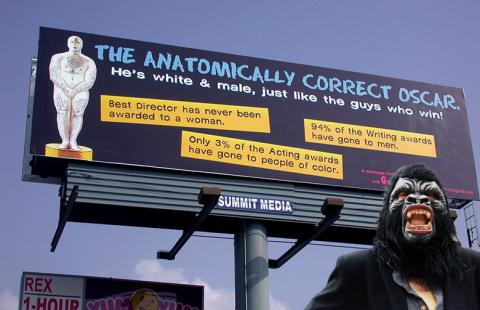
The Guerrilla Girls are female protest artists who use culture jamming to expose sexism, racism, and corruption in the art world. The above image is an example of a billboard that went up in Hollywood in 2002 following the Oscars. The group of women, who maintain their anonymity by disguising themselves under gorilla masks, combine humor and facts about injustices in the culture in to their art and make it public to uncover issues.
The use of provocative yet witty statements supported by statistical information or data work together to unmask the hypocrisies and dominance of the white men in the arts and Hollywood, the places where women and artists of color seem to remain on the outside. They target the people who are actively playing a role in the politics of discrimination but also cause passive participants to consider the injustice that they are witnessing. In this instance, the Oscars which is a famous award ceremony known and watched all across the United States is called in to question and exposed by the Guerrilla Girls for their sexist and racist awards and exploitation of the female figure.

Analytic Post – March

This month I have chosen to take a closer look at the Instagram of Bollywood Tacos and analyze the way they present themselves online as well as consider the visual narrative that they are telling. To make it further March-y, I specifically chose images and captions posted on the Bollywood account this March as examples, as seen above.

It is clear that Bollywood Tacos (BT) is trying to create an online persona to motivate viewers to come eat or drink their products. The feed of @bollywoodtacos consists of vibrant and highly saturated close-up photographs of diverse, seemingly satisfied people, drinks, and food. Looking at the feed from the account profile view, where each image is fit in to a small square, the colors play off of each other due to the abundance of complementary color schemes present. Each photo seems to include a combination of violet and yellow, blue and orange, or red and green, which all viewed together help emphasize and lead the viewers eye to bounce around easily between photos. The images are each accompanied by individual captions that further suggest a playfulness about the experience of eating or drinking at BT. The words anchored (captions) to the already visually interesting images are goofy and relatable. By combining images with words in such a way that is attractive to viewers, the perception is that the Narrator (Bollywood Tacos) is this funny, goofy, almost careless, but likeable persona. This strategic effort by the creative director(s) of BT ultimately develops the narrative that it is an enjoyable and fun place to go to where young people like to eat, drink, and go out.

The narrative of this body of images works because it seems both probable internally and truthful externally, which relates to Walter Fisher’s Narrative Paradigm Probability and Fidelity. Internally the images depict people interacting with the food or drink products of Bollywood Tacos, inside the restaurant Bollywood Tacos. All of the interactions seem probable, though it is clear that some images are more spontaneous while others are definitely posed. The food appears to match the description of the restaurant and the people in the images seem to match the assumptions made by the accompanying words, making the viewer believe that the imagery and perceived persona is logical. Second, externally we know that BT is located in downtown Milledgeville which is right next to multiple college’s, which lends to the external fidelity in the sense that the content BT’s Instagram is proposing does seem consistent with the expectations of the community in which it exists. What we know outside of the narrative that BT has created adds up, therefore making it seem reasonable as well.

Bollywood Tacos Instagram has connected images with words in such a way that tells a persuasive story to online viewers and perspective customers.

Analytic Post 2

In Finnegan’s The Naturalistic Enthymeme and Visual Argument: Photographic Representation in the Skull Controversy, she suggests that photos from the “skull controversy” of the 1930s constitute a “naturalistic enthymeme” in which “we assume photographs to be ‘true’ or ‘real’ until we are given reason to doubt them. (Finnegan, 135)” She explains that the that the controversy surrounding Rothstein’s infamous skull photograph resulted from the naturalistic enthymeme which allowed for an argument to be both useful for public debate and vulnerable to refutation (Finnegan, 136). The viewer’s experienced conflicting feelings toward understanding the manipulation of the scene or framing of the photographs versus their intended interpretation. The natural enthymeme within images works by drawing on cultural context, shared knowledge, or shared experience to carry a message and expects that viewers to have the ability to decode the links.

This is why so many images that we remember seeing in history classes held so much impact to us. For example, the following images from the Great Depression and the Civil Rights Movement.

Police drag Ruth Tinsely away from a Richmond store, 1960

https://www.virginiahistory.org/collections-and-resources/virginia-history-explorer/civil-rights-movement-virginia

Image result for great depression photos

https://www.history.com/topics/great-depression

Because of our education and the context that we had been given, even though these images were ‘real’ photographs, they made us feel and think a certain way. They were clearly framed by a photographer and due to our understanding of the context, they mean something to us.

Beyond historical documentations, while reading Finnegan’s analysis, it was hard not to read her ideas and relate them to my own life and current experience. I realized that there are so many images that I see on a regular basis that genuinely just make me feel some type of way. I think this has a lot to do with what Finnegan is talking about. For instance, I think about certain ads I remember seeing on TV when I was growing up for various dietary or beauty products where the female body was manipulated in some way. On one hand I remember thinking about how beautiful the women in the ads were and how it drew my attention to the product; but on the other I think about how harmful the ads often were, and how the feminist in me hated them. Similarly, I considered the way I am constantly conscious about how people on social media are heavily editing, adding effects, or overlaying filters to look a certain way or give off a certain perception online. If it’s too obvious, I often judge them for it or feel annoyed… almost like it is distrustful. But at the same time, even I edit my own photos to make them look better.

It is an interesting cycle and but I definitely think it is something to consider. Just because a photograph is displayed with some kind of intentionality or manipulation does that make it unrealistic? Understanding the naturalistic enthymeme as Finnegan describes is very useful. In my opinion it is about having the tools to decipher the image itself from the associated meaning. We can still look at photographs expect to see truth, but it is important that we understand there are often meanings within them, and they may have been manipulated.

Finnegan, C. A. (2001). The Naturalistic Enthymeme and Visual Argument: Photographic Representation in the ‘Skull Controversy’. Argumentation & Advocacy37(3), 133-149.

Analytic Post 1


In honor of the Super Bowl this weekend, I thought it would be an interesting time to consider the image behind a national controversy surrounding American football and politics: Colin Kaepernick kneeling during the National Anthem before competing in NFL games.
This subject is one that, as Americans, we have, at the very least, heard of and talked about to some extent in the past year. We have heard the battle between political parties and their beliefs about it, accusations of being unpatriotic, and the voices of the Black Lives Matter movement. But we don’t often discuss what is actually the core of unrest when it comes to the act of kneeling vs. standing during the National Anthem. Using the concepts that we have discussed in class so far this semester, rather than merely discussing the politics of the matter, I’ve decided to rhetorically analyze this image with attention to the implications of kneeling vs. standing as a sign, and consideration for how the technological and social modalities influenced its reception.
 
First, I think it is important to think about the traditional social implications of kneeling. In many cases kneeling, or “taking a knee,” is seen as a sign of respect and devotion. For example: kneeling in the presence of royalty, athletes “taking a knee” on the soccer field when another player is injured, or a man getting down on one knee while proposing. Typically when we see the gesture of kneeling, we do not associate it with protest or anger. The image of someone kneeling being positive or respectful has developed from cultural norms and expectations over time. When we see a man and a woman together and the man gets down on a knee, we can assume what is going to happen because that gesture signifies a proposal in our brains. Kneeling is a sign to us. Think about this: Would it be odd to if your significant other did not get down on one knee when proposing? Would that be right or wrong? On the flip side, would you consider proposing to someone without committing this gesture? Or is that already something you would do without conscious thought?
My point is that the cultural expectations that can come with certain signs, even things as simple as the body’s physical positioning during specific cultural situations, is incredibly important to the people within that culture. If the expected behavior is not carried out, it can cause significant confusion or concern.

Likewise, during the playing of the National Anthem, it is expected that Americans stand. The act of standing is meant to signify respect and honor to the American flag, the military, and the country. Therefore, the juxtaposition of a traditionally respectful body posture (kneeling) during a time when there is a cultural/social expectation for standing confuses the viewers. They do not seem to go together. The sound of the National Anthem is a signifier for people to stand to signify their respect. Choosing not to do this is choosing to go against an agreed upon social expectation, and with that comes the confusion. Is Kaepernick being disrespectful of the American flag or displaying ignorance? Is he trying to signify respect for something else by kneeling?
 
Even without any political context, when people watch an NFL match over television or while they are standing in a stadium, whether or not they are consciously aware that they are looking for it, they will notice when someone is doing something that disrupts their expectation. With this in mind, it is clear that Kaepernick knew he would be seen when he made the choice to begin kneeling rather than standing during the National Anthem before games. He has taken advantage of his access to the modality of the media and widespread communication to illustrate his message. By doing so he directs attention to himself and displays an image of himself that illustrates his lack of approval for something that he believes the National Anthem or the flag might symbolize to him or the American people. This image makes people think. It is not the words that he is saying, but rather the image that he is displaying, and it’s incongruence to cultural expectation that causes unrest and implies his message.

-Sarah Bergin 02/03/19

Mini blog 1

The ideology of “The Good Eye,” as described by Rose, expects that the viewer accesses an image based upon compositional interpretation – describing an image as it is, without attaching much abstract thought or embedding philosophical interpretation. An understanding of artistic terminology as well as a bit of contextual information is important to understand an image in this way.
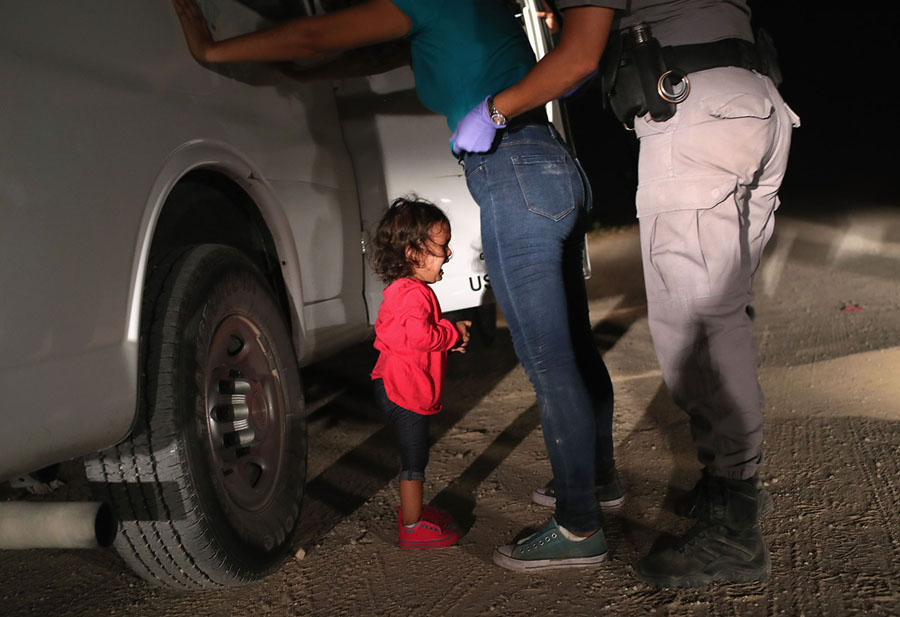
With Rose’s theory in mind, I have chosen to look at the above image. We can see that this image depicts three figures undergoing some kind of interaction. The larger figure on the far right, likely male based on size and height in comparison to the much smaller adult female in the center, appears to have the authority. The female character in the center is submitting to being pat down, with her back to the larger figure, while her hands are placed against a vehicle marked with a word beginning with the letters “US.” It could be assumed that this vehicle, as well as the authoritative figure, belong to the U.S. government. The third figure is a small female child. She is focal point that demands attention in this image. Her face is the only one that is actually visible, as the other figures are cut off of the hip.
The photographer of this image clearly wanted the viewer to see this image through the perspective of the child, whose facial expression is one of extreme fear, terror, or sadness. The child stands closest to the vehicle, beneath the arms of the woman which are extended to the vehicle. The little girl is facing toward the adult female in the center, who is likely her mother, but the mother who is being frisked is unable to console her. The expression on the young girls face emphasizes how helpless she is, but the arrangement of the figure suggests that the mother is trying to keep her body between the authoritative figure and the girl, so as to protect her. The photographer strategically managed to arrange the photo so that the brightest light in the image provided a focal point right in the center of the image where the young girl is. The only light in the image appears to be coming from a vehicle as the quality of light is white like a headlight. It is clearly night time and the dirt on the ground suggests that whatever road they are on is not highly traveled or trafficked.
The composition of this image makes us feel as though we are on the level of the child. We can clearly see and understand her emotion, even with a lack of other clues in the image.

-Sarah Bergin 01/24/19