Mini-blog post 6


These are a few pictures from one of the places on campus that I get the majority of my work done. This is a small studying area on the second floor in the back of Beeson Hall. I chose this place because I tend to spend more of time here rather than the library. There is no traffic constantly flowing through here causing distractions. It’s a quiet area but the windows facing and behind both sets of chairs allows natural light to come into the area and provide a feeling of warmth rather than being cooped up in a small room with only the company of fluorescent light.

The way this area is set up, there is plenty of space for one individual to sit, study and work all in a quiet and non-distracting environment. This section of campus also allows up to four students or individuals to sit comfortably and work as well.

The dry erase board is an additional piece of architecture that belongs in this area. It allows students to write down notes and ideas while collaborating with their peers, or an individual to write this down for memorization in a study session.

This area is perfect for students and even professors to sit, study and work together on assignments and ideas while not being in the congested area of the library with numerous distractions. This spot is significant to me because when I need to buckle down and get work done, a place such as this one os the best area for me to tackle responsibilities.

MBP #6

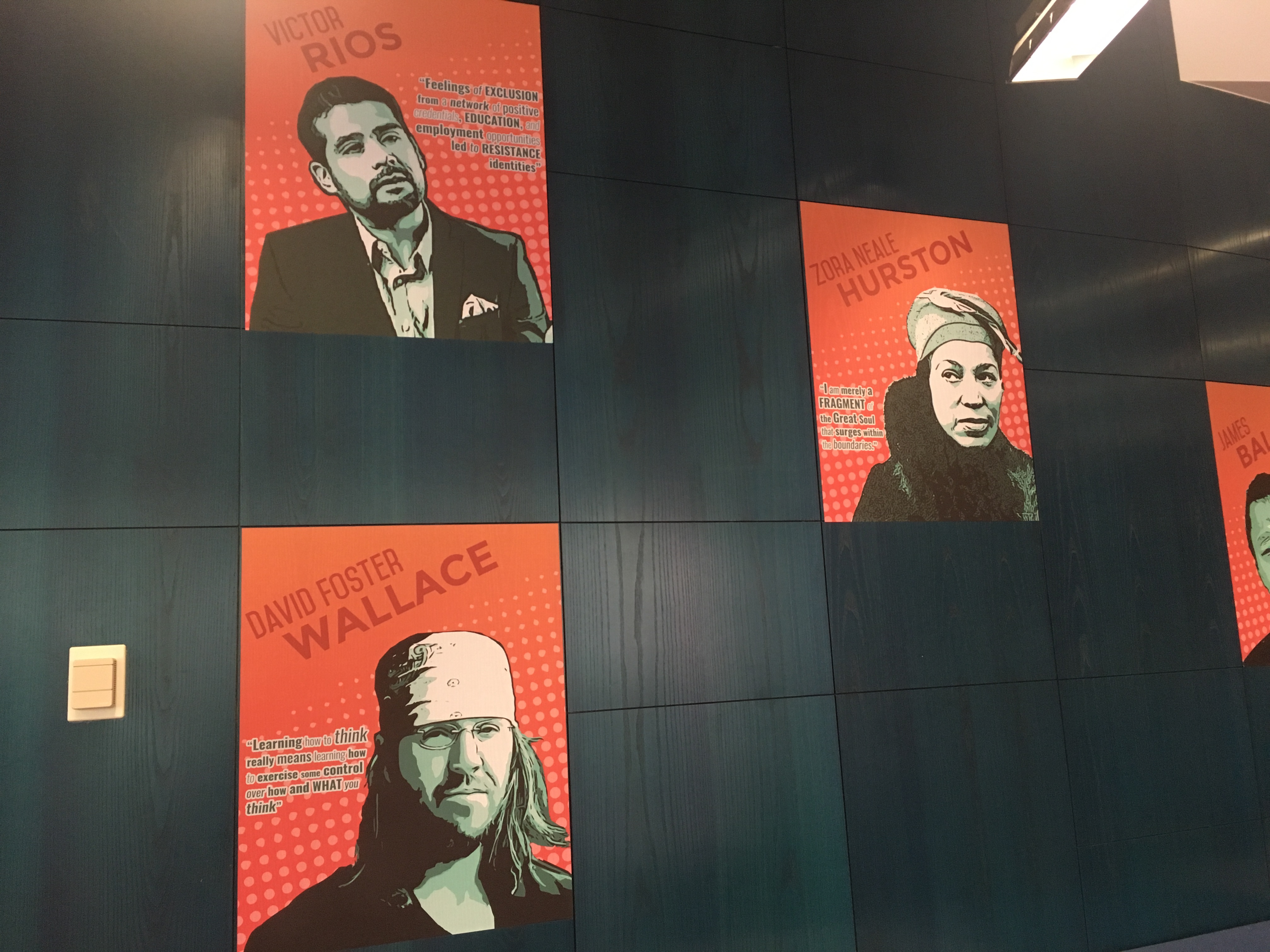
These are pictures of one of the study spaces at Ina Dillard Russell Library. The chairs in the center of the room are arranged in a circle, implying that this is a space for discussion and collaboration. There are also big windows on the side of the space, which bring light into the area and make it a more comfortable, bright, happy space to share ideas. The posters on the wall showing famous authors are used to (re)present that this is an educational space for students and show that the success of the authors can also be achieved by students. In addition, the diversity of the authors and colors of the space show that this is a place for creativity and diversity. This is a space for students to collaborate and learn, as shown by the big windows, the desks in a circular shape and the educational posters.

MBP 5

Related image
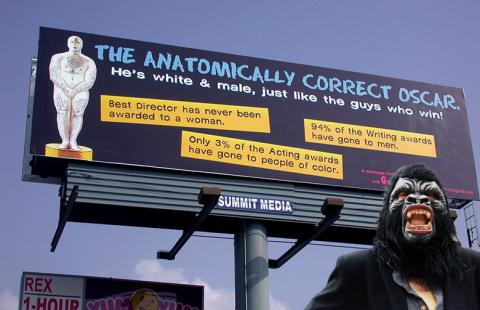
The Guerrilla Girls are female protest artists who use culture jamming to expose sexism, racism, and corruption in the art world. The above image is an example of a billboard that went up in Hollywood in 2002 following the Oscars. The group of women, who maintain their anonymity by disguising themselves under gorilla masks, combine humor and facts about injustices in the culture in to their art and make it public to uncover issues.
The use of provocative yet witty statements supported by statistical information or data work together to unmask the hypocrisies and dominance of the white men in the arts and Hollywood, the places where women and artists of color seem to remain on the outside. They target the people who are actively playing a role in the politics of discrimination but also cause passive participants to consider the injustice that they are witnessing. In this instance, the Oscars which is a famous award ceremony known and watched all across the United States is called in to question and exposed by the Guerrilla Girls for their sexist and racist awards and exploitation of the female figure.

Mini Blog Post #5

anticonsumerism-online-8-728

This image is a clear example of culture jamming because it pokes satyrical fun at McDonald’s, an American institution in the world of food. The statement in this image, “Eat fast, Die Young”, is criticizing Americans’ need and desire to consume fast food. While this image specifically targets McDonald’s with the use of the sideways “M” as an “E”, it can easily be used as referencing the fast food industry as a whole. This is an example of culture jamming because it takes a common message or a familiar image and points out the flaws in it; it breaks down the seemingly polished and happy aspect of McDonald’s and how people are “lovin’ it” and reveals the true nature of the food and the fast food industry as a whole. This image sends the message that the momentary pleasure of fast food will lead to a lifetime of bad health, and a shortened lifespan overall. 

Mini Blog Post #5

justmakeitAccording to Harold, “[culture jamming] seeks to undermine the marketing rhetoric of multinational corporations, specifically through such practices as media hoaxing,corporate sabotage, billboard “liberation,” and trademark infringement (190).” This image of the Nike Logo filled with children from a third world country and with a parodied version of the Nike slogan reading “just make it” is a good example of a culture jam. The intersecting discourses are the ad campaign of Nike presenting themselves as a sports brand that will inspire the consumer to success and the discourse surrounding the use of child labor from third world countries to produce products such as Nike. This image subverts the original purpose of the Nike “swoosh” which ordinarily signifies speed and accomplishment, urging the consumer to “Just Do It”. However, by adding the face of children in the swoosh and changing “Just Do It” to “Just Make It”, the point is being made that Nike is treating children like slaves to produce their products. Instead of “Just Do It” because Nike products will make you good enough to succeed, the point is “Just make It” because your family is starving and Nike has the money that you need, so don’t complain.

Mini Blog Post 5

For this blog post, I decided to use this picture as an example of pranking rhetoric in the form of “Culture Jamming”. I have seen this type of rhetoric before on social media, but I had never thought it had a name or a deeper meaning. In the article Harold talks about a distinct difference in traditional media pranksters and cultural jammers saying, “media   pranksters,   an   increasingly   active   type   of   consumer   activist,   prefer affirmation  and  appropriation  to  opposition  and  sabotage.  Whereas  the  culture jammer  as  saboteur  opposes  commercialism  through  revelatory  rhetoric  such  as parody, pranksters can be seen as comedians, as playful explorers of the commercial media landscape.” Understanding this difference is key in uncovering the intent behind meaning and cultural relevance of these type of enthymemes. This is an example of pranking rhetoric because it is not directly in opposition of any argument. Instead, it looks at the dominant reading and through reconfiguration redefines the meaning for an audience. In my example, the dominant understanding is that YouTube is a social platform with videos, and in this it is playing on the fact that many people use it to watch cat videos instead of using it as it was intended—a social media platform.

MBP #5

This parody of the Starbucks logo is an example of culture jamming. Culture jamming is an example of rhetorical protest. The protest in this image is to say that Starbucks coffee is way more expensive than it should be and it’s stealing your money. Furthermore, we as a society are allowing it to steal from us because we continue paying for overpriced coffee.

Culture jamming, as Harold states, “seeks to undermine the marketing rhetoric of multinational corporations, specifically through such practices as media hoaxing, corporate sabotage, billboard ‘liberation.’ and trademark infringement.” The most practiced/prevalent form of culture jamming is ad parody. The example of the Starbucks logo is an ad parody with word play “Six bucks coffee.” This is a light and humorous tactic to point out Starbucks as a multinational corporation that is commonly known for selling coffee that is overpriced.

As Reverend Al, of the Cacophony Society pranking group, states, “[pranks] don’t punish, they provoke. This logo is not meant to shame those who go forth and continually pay $6 for their mediocre cup of coffee with all the fancy fixings but rather to point out that Starbucks is overpricing their coffee and we, as consumers, allow it. It’s making aware of the price of the coffee, not implying that we shouldn’t pay for the coffee.

MBP #5

Image result for culture jamming

Culture jamming is defined as a tactic that subverts the power of media, government and corporations to control and distort information that they give to the public in order to promote consumerism.

The above image is a distorted picture of the Facebook logo. Instead of “Facebook” they changed the latter of the word to crack referencing the drug and how Facebook is an addictive social media platform.

This type of culture jamming causes destruction to the already world known and noticeable logo. Adding the slogan up under it, “Facecrack helps you waste time and stalk the people in your life,” throws criticism towards people who use Facebook for reasons other than keeping up with family members and old friends. There are over 2 billion Facebook users in the world and according to an undergrad study, nearly 98.83% of people are active on their Facebook account.

While Facebook is intended to be used for keeping in touch with old friends and family members, mass culture relates Facebook users to mindlessly scrolling through their news feed, sharing pointless videos, and stalking people you know and don’t know to see what they’re doing on the weekends and in their free time.

Although this is a funny way of culture jamming the use of Facebook, culture jamming also opens our eyes to the realities of products, corporations and brands.

MBP 5

For my fifth mini blog post I choose an image that makes fun of McDonalds. Like the Adbusters magazine this picture uses the tactic of culture jamming which is an anti-consumerist movement that disrupts media culture by using already existing ads to show us the reality of what’s behind the ad. This act of culture jamming causes destruction of the ads primary goal of selling a product and creates a spin off or a parody of what is hidden in the ad itself.  For example, the picture I used flips the M for McDonalds and uses a W which stands for weight. Underneath the W we see what should be the saying that we all recognize “I’m Lovin’ it” with “I’m Gainin’ it”.  Considering that a Big Mac meal has a total caloric intake of 1,080 out of our regular 2,000 daily intake, it is safe to say that this ad is very effective with the saying of “I’m Gainin’ it”.  By utilizing culture jamming this ad attempts to uncover the methods of dominance of a mass culture to promote progressive change. Culture jams are intended to expose and raise questions about our society’s advertisements and uproot what we fail to see or what is hidden in the advertisement. This advertisement of McDonalds uses these captions to create awareness of issues with McDonalds advertisements to show the negative side of the product. By discussing a brand or a product in a different way than what we are used to seeing, it can promote change in someone’s lifestyle choices, in this case not eating at McDonalds. Another thing that culture jamming does is that it attempts to make links between the message and the issues of the product. Although over the past decade McDonalds has made great efforts in changes for the quality of the food, there are still many other healthier options of fast food that we can choose. Since McDonalds has never been a company that is known for “healthy” options it makes the corporation a huge target for culture jamming. Even though magazines like Adbusters attempt to promote cultural and health awareness for certain products, there is no way that everyone will get on board with staying away from eating at McDonalds. However, culture jamming is still very effective for some people and is necessary in our society to show us the truth about the products we use and consume.

MBP #5

Culture jamming is an action that “undermines marketing rhetoric of multinational corporations” (Harold, 2004, p.190). The above image is an example of culture jamming. Apple tries to promote a certain type of rhetoric about its brand to consumers that it serves its customers in every way possible. Its devices are there to make consumers’ lives easier; there is an app for everything to make your life simpler. This image exemplifies culture jamming because it disrupts these discourses. It brings attention to the addictiveness of Apple culture and how technology is replacing human interaction and replacing enjoying real life.  Once starting to use more apps and Apple products, you begin to feel like you “need” all the latest Apple products in order to survive. The image “jams” the idea that apps make your life easier, and instead points out how they make consumers care more about their phone than what is happening in their own life. It shows how, despite what people may think, Apple products can be just as addictive as smoking cigarettes, especially with the message put out to consumers that they NEED Apple products.