mini blog post #5

Image result for flash mobs

An example of culture jamming in a flash mob. Harold describes culture jamming as “a word in which one disrupt existing transmissions. It usually implies an interruption, sabotage, hoax, prank etc.” (92). A flash mob is a group that gathers together in public in an effort to entertain for a brief time. It is never something that people expect, but just shows up in a public area. Before a flash mob comes up people may be enjoying a meal or simply walking about enjoying their daily life. Then the flash mob will begin, taking people by surprise and causing everyone around to stop what they are doing and watch. They have different intentions for performing this and sometimes it is solely for entertainment, sometimes it is for a surprise engagement and other times to get a message across to the audience. They take advantage of the power they have to entertain and disrupt normal activity with a strange organized flash mob.

Mini Blog Post #5

This picture distills the essence of what culture jamming is by using multiple brand symbols to outline the problem with the manufacturer-consumer cycle. Using the appropriation method of culture jamming, the creator of this image seeks to associate these brands – and possibly corporate culture as a whole – with a predatory capitalistic cycle. The performance here is a parody taking these recognizable brands and using the visual association that viewers might have with them to criticize their true nature. While it is a very surface level example of culture jamming, it puts is meant to put in the viewers minds the true intentions behind these companies rather than the simple idea that they would like you to buy their products. Rather, it wants the viewer to understand that they are part of a cycle of living to buy.

Analytic Blog #3

VR4VR 2VR7VR6VR8VR3

The social group that I chose to use for a more descriptive narrative was Milledgeville’s very own Blackbird Coffee house. I will use these images above to do a narrative analysis using Bossen and Freedman as a model.

These images were taken from Blackbird’s Facebook page which I believe showcases the organization well as a whole. In Bossen and Freedman’s article, Dusseault’s photograph of the landscape “enables the viewer to understand change over time and the remaking of one type of space into another (79). The images are strategically placed starting with the outside of the coffee shop and moving its way through the cafe. College students pass by this window with “Coffee, Roastery, and Cafe” on it everyday on their way to class, and it would not be fair to leave it at that. When you go inside, you see where the magic happens. From the view point of the baristas we see Espresso into a mug and the register to take the order of the next person who walks into the door. The next image is of a coffee mug which is a common site all over campus, as students and professors alike will take a coffee break and head to blackbird to get coffee. Students enjoy this local cafe which also offers merchandise which is seen at the end of my visual narrative. Not only do customers enjojy the coffee they provide, but they also show their increased love for Blackbird through purchasing and wearing their merchandise.

This photos present themselves on Facebook as informative, welcoming, enjoyable, and progressive. They inform you on what the organization is all about and their vision behind opening it. By showing the entrance of the building they welcome you in, showing you the experience to be had on the inside. They progress as they show different aspects of the store and the journey to be had while inside, from entering the building, to purchasing coffee, to enjoying coffee, to enjoying the scenery, to investing in their merchandise.

As Bossen and Freedman discuss the methods used in photography, Molten Light was something I saw represented here. In order for an image to be considered Molten Light “a photograph must sit at the intersection of art and industry and must move beyond pure documentation to reveal interpretative aspirations of the image maker (78). The images of Blackbird not only document their story of blackbird, also show forth their vision behind it. A friendly, social environment where people from all backgrounds can come gather and enjoy one another’s company. The photographs desire to draw people in to see the same interpretation.  As we look to the physical aspect of this pictures, it is important to also recognize the deeper internal meaning being portrayed. the literal analysis see in the Blackbird visual conveys bright imagery with similar colors throughout the pictures. We also see the logo of a black hand drawn bird, hence Blackbird. When we begin to look more at the deeper meaning of these images, we see the pathos going on here. A girl is enjoying the gift of fellowship, as well as, life. It is not just the coffee, merchandise and store that makes Blackbird good, although they are. It is the fellowship had, the relationships nurtured, the productivity and ideas discussed and put into action, and the joyful experiences had overall. It is the ambiance of it all the really draws people in to the visual of it all. The evoke a sense of wanting to accomplish something and make a difference in this world.


ABP March

Barbatsis’ narrative theory looks into the way people communicate. Barbatsis believes this is through stories. This is how information is told and passed down. Therefore, the narrative becomes an important aspect of not just rhetoric, but visual rhetoric. Barbatsis overviews the basics of narratives and storytelling. This includes characters, plot, actions, etc… that can be picked up on.

Then, Barbatsis, breaks his narrative theory down into two parts- the descriptive structure of an image and the literal structure of an image. Barbatsis explains the descriptive structure of an image as outward-looking (to go outside the reading, from individual words to meaning). The literal structure is more inward-looking. This is looking at the words, the captions, etc… If there are no words then the literal meaning can mean the angle, lighting, closeness, or other similar aspects of an images literal sense.


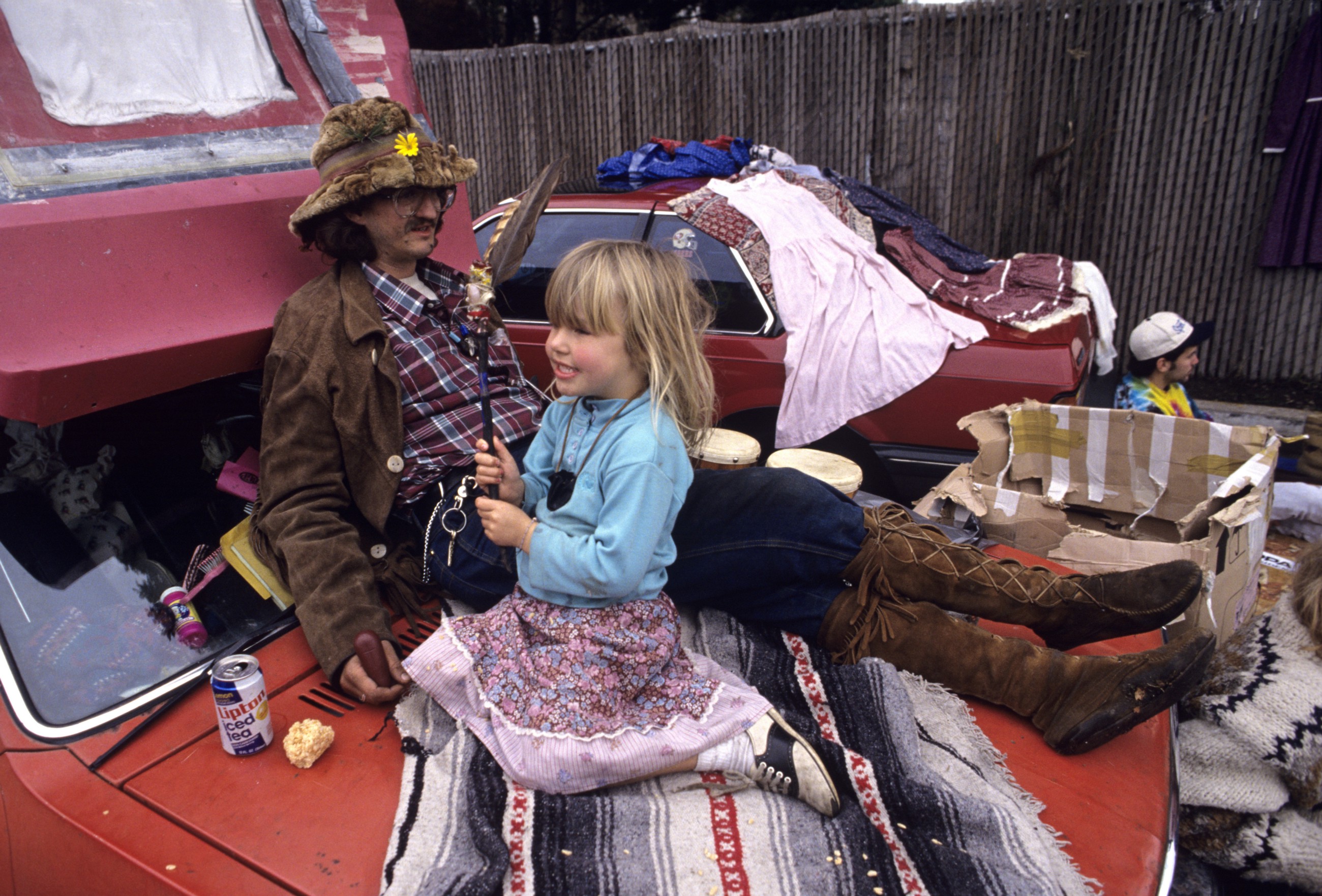
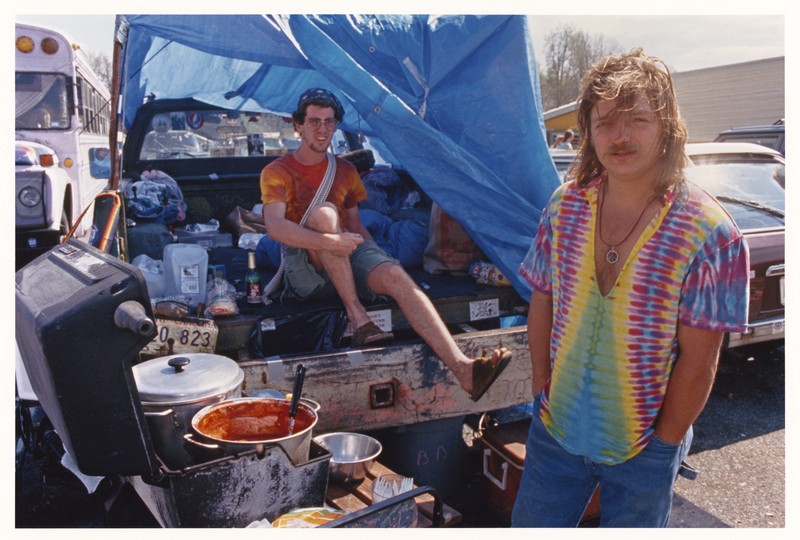
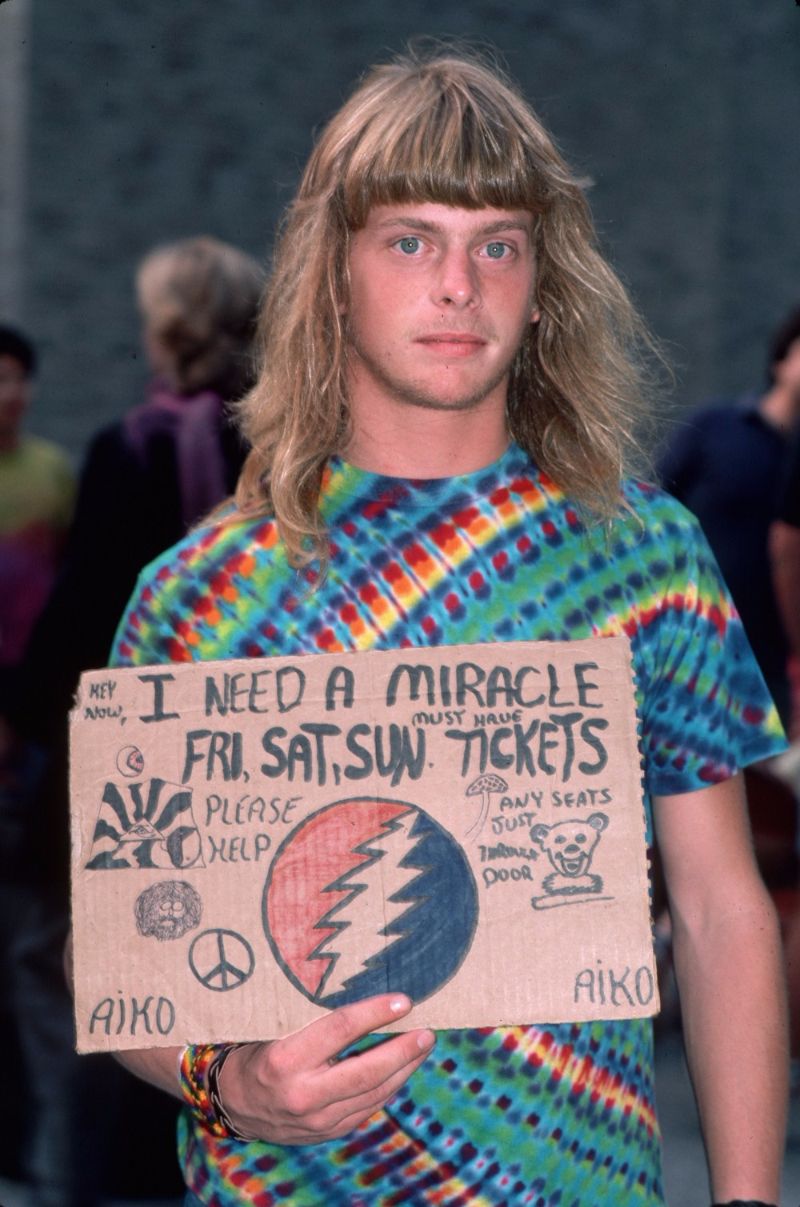
These images, derived from different times and locations, tell a story. The images depict fans of the Grateful Dead. These fans, known as Deadheads, created a counterculture based around peace and the coming together of the community. These people are known for their odd, counter-cultural looks, haircuts, and clothing. Deadheads are known for their use and acceptance of vibrant, psychedelic colors, especially for clothing. It is easy to spot or identify fans of the Grateful Dead, especially if you are in the USA. This is because Deadheads are understood and embedded into our cultural understandings.

Based on Barbatsis’ theory, these images tell a story. This story can be depicted through descriptive structural analysis or the literal structure. The narration we get from the images is one with people, a location, signs, words, images, colors, cultures, and life. There are also ideas, values, and beliefs that can be drawn from the images, especially if the viewer has a cultural understanding of this group of people.

Looking directly at the literal structure of the images, we have to look inward, to the text or ideas that the image tells us directly. The literal structure of these images show clothing with many colors, or tie-dye. The people’s clothes are worn-in and raggedy. The people are sometimes shirtless. The men photographed in these images all had long grown-out hair, or grown-out beards. Their faces are easy-going and seem care-free. There are symbols present in the images. These include a symbol for peace and the symbol for the Grateful Dead band. We see a man with a child. The child is on top of the hood of the car relaxing with the man (probably her father). So, there are not only men pictured. There is a picture with two men who have turned their car into a tent to live and cook in. In the last image, there is a man holding a sign which asks for concert tickets. By the people’s faces, you can tell that they are content or happy. They seem merry-go-lucky.

The descriptive structure of the narrative told by these images looks beyond the text or the image itself. The clothing choices and colors in coordination with their hair length and beard length give us some insight about the counter-cultural ideals that these people may have. With the proper cultural understandings we know what tie-dye meant during the 1960s and 70s. We also know about the hippie movement, and this is probably why most of the people pictured have longer hair.

In the last image, the sign that asks for tickets, with a Grateful Dead symbol, tells the viewer what band they want to see and what time period this could possibly be if there is a cultural understanding of the symbols present.

There are many ways of understanding the images and the narrative by looking beyond the image itself. By the way the people have their cars and tents set up, you can suggest that these people are doing more than just going to the shows. They are living a lifestyle that involves dropping the dominant ideologies of what is important in life. You can infer that these people are living in congruity to the symbols of peace, by the symbol of peace being displayed in the images. The men have long hair, which is a symbol of counter-cultural beliefs at the time. You get the picture that these people are living alongside the “hippie” movement of the 60s and 70s because they operate and display themselves in very similar manners.

Analytical Blog Post #3

Preamble: The following blog post is an analysis of how reformed Christian Facebook represents itself and its ideologies. To conduct this analysis, I did the unthinkable, I sacrificed my integrity and values and requested to join the “Reformed Pub” group on Facebook. As a reformed Christian myself, I use such strong language to describe this group for a few reasons that will be discussed in greater detail further into the blog post. First to define terms, I define “reformed Christianity” (or Calvinism) as essentially a Christian who affirms the theological teachings of John Calvin and other early theologians of the Protestant Reformation. Moreover, Merriam-Webster defines “ideology” as a manner or the content of thinking characteristic of an individual, group, or culture.” For the sake of this blog, the ideology of reformed Christians will not refer to the explicit theological belief, but rather the implicit cultural beliefs that make up what is commonly referred to as “the Cage Stage” in Christian circles. “Cage Stage” refers to the attitude of self-righteousness and superiority shared among many reformed Christians, the idea being a young Calvinist should spend a few years caged like an animal to protect the outside world from the shear arrogance and smugness protruded. The “Reformed Pub” on Facebook is the largest community of Calvinists on Facebook; a group of 20,846 reformed theologians discussing their favorite craft beers, showing off pictures of their families and beards, and getting into heated debates in comment sections over the slightest variation in scriptural interpretation. I requested to join, but have yet to hear back, so I requested to join the second largest community of Calvinists on Facebook, “Reformed Pub: Unmoderated”. I was accepted within minutes. 2,434 members with only one rule “follow the Facebook terms of service”. This group turned out to be everything about the “cage stage” enveloped into one Facebook group. After perusing the photos of the group, I was able to come up with three different categories that summed up the unfiltered reformed Christian culture. These three categories are photos of alcohol/beer, photos/memes about family, and photos/memes meant to stir up controversy and start a debate.

Screenshot (16)

The first category is photos of alcohol/beer, this image is a good representation of a standard post in this category. A characteristic of reformed Christians is the liberal take on the consumption of alcohol. A typical Calvinist will hold a moral objection against drinking to the point of drunkenness but has no problem with drinking for the flavor of alcohol. For this reason, it is common to see pictures taken of whatever brand it is the poster is drinking, showing off their taste in alcohol as well as the liberty they have in their belief in the morality of drinking. This reflects the sense of pride that many reformed Christians have in their belief system that allows them the freedom to savor the flavor of alcohol and show off to their friends. It also reflects the cultural significance of alcohol to reformed Christians; still maintaining that drinking to drunkenness is sinful, most reformed Christians drink alcohol exclusively for the flavor and take cultural pride in their refined pallet for booze. It is not uncommon to see reformed Christians posting about their favorite craft beers and even sometimes getting into debates over which brew is superior. In this case, the ideology on display is the pride taken in the belief system that allows reformed Christians to drink and the pride that is taken in the refined pallet of reformed Christians.

Screenshot (17)

For the sake of the privacy of the posters, I took the effort to black out the profile pictures and names of the members of this group. This group, while accepting to anybody, is ultimately a closed group, making this group and the subsequent profiles fall into the “publicly private” category of information availability. Silvestri defines “publicly private” as “author identification and profile information are available, but the content they create is only available to a closed network of friends and family (Silvestri 109). Wishing to respect the privacy of the posters, I chose to not show any pictures of families to demonstrate my second category. Rather, this meme does a good job of illustrating the ideological value of family and marriage. One of the most common demographics for reformed Christians is married-with-children dads in their late 30s, followed closely by single white men in their 20s-30s who desperately want to start a family one day. This ideology traces itself back to the concept of marriage for reformed Christians. The most common belief when it comes to marriage is the traditional view of marriage being between one man and one woman. As implied by this post, for reformed Christians, having a traditional family structure is a source of theological understanding. This is because the love shown in marriage and parenting is supposed to reflect the love shown by God to His chosen/elect. For this reason, family values are emphasized in this group, because those values also display a level of implied maturity and understanding for reformed Christians.

Screenshot (15)

The final category is the photos the try to stir up controversy and debate. This meme in the popular “Change my Mind” format succeeds in starting a debate over the Biblical office of Elder. There are a few ideologies on display here, first being the distaste with Catholic theology and second being the authority of the Christian Bible. The poster compares protestant Pastors to the Catholic Pope/Clergy, relying on the reformed Christian commonplace (ideology) that the Papist is not a Biblical office. This is an enthymeme, with the implied premise being the commonplace of Catholic insufficiency. The office of the Pope is unbiblical, the office of the pastor is identical to the office of the Pope, the office of the pastor is unbiblical. The response which sparks the debate also uses the authority of the Christian Bible as another unspoken premise, which leads to an argument about what the Christian Bible *actually* means. This post displays the confidence that many reformed Christians have in their personal belief systems, and how willing they are to debate even the slightest of issues. Since reformed Christians believe in the authority of the Christian Bible and they think they that they have interpreted the Bible correctly, any attack on this interpretation is an attack on the intellect of the reformed Christian. This pride is characteristic of the “cage stage”, Calvinists have gained a negative reputation because many Calvinists are unwilling to back down from a debate.


I understand that many of these posts were memes and jokes not meant to be taken too seriously. However, the stereotype of the “cage stage” does exist for a reason, and that reason can be seen when looking at a group like “Reformed Pub: Unmoderated”. I fully believe that each post I looked at was entirely innocent, but still contained remnants of the culture that they were born from. This culture tends to breed a reputation of arrogance and smugness. As a self-proclaimed reformed Christian, I am part of this culture and so I take great care to make sure I understand our weaknesses and how they manifest in simple Facebook posts like the ones analyzed in this Blog Post. I want to see a better online representation for my beliefs that more accurately display the ideology we hold to that does not have any room for arrogance and pride. Of course, I believe most Calvinists do not fall into the “cage-stage” including those who were included in the posts used in this blog post. However, I do think that there are unconscious biases born out of ideology that feed into the stereotype of Calvinists.

Reference: Silvestri—Shiny Happy People Holding Guns

Analytic Blog Post #3

funny-wendy-jokes-fb5__700-png

In her article, Gretchen Berbatsis describes Walter Fisher’s narrative logics as well as the different structures within narrative theory. This blog post will use a survey an image that represents the classic mean tweets that fast food restaurants often exchange, more specifically, the Wendy’s franchise. We will first examine the story being told in these images. While none of the tweets are directly related to one another, they all have the same theme and general effect. Using Fisher’s two parts of narrative logic, probability and fidelity, we will determine if a) the story makes sense and b) how faithful to reality they are. Take the tweet about McDonalds. When one user asked to find the nearest McDonald’s, Wendy’s cleverly tweets back an image of a garbage can. First, this response is highly enthymatic in nature. The viewer has a basic understanding of the question being asked: where is the nearest McDonald’s. The viewer also knows what a garbage can looks like and is used for. Thus, when Wendy’s tweeted an image of a garbage can in response to a McDonald’s, the viewer understands the implication: that McDonald’s is equivalent to trash. The ability of the viewer to fill in these blanks successfully is proof that the image and the story it tells make sense to the viewer; this assumption falls under Fisher’s probability element. Next, Fisher’s fidelity element states that the image has to be faithful to reality. In order to determine this the viewer must use evidence that is separate from the image itself. For example, the fact that fast food restaurants (Wendy’s in particular) cruelly tweet at one another is a piece of information that the viewer needs in order to understand the image. If the audience were unaware of this fact, this image would appear far removed from reality. A restaurant does not often participate in technological activities, after all. Going off of this last statement, we will now analyze this image with the discursive structure of narrative theory. The discursive structure in its’ simplest form essentially states that there are multiple audiences, narrators, and narratees for every image. First, there is the person who actually wrote the story being told. In this example, that is likely an employee for the Wendy’s corporate office, possibly an intern. Next is the implied writer of the story. An easier definition of this is the person you imagine having written that story. In this example, many people believe a witty young person writes the tweets, even though the reality is that it is likely a low-payed employee. Third is the narrator in this story from the first person perspective: Wendy’s. Next we will cover the audience members. Each story has a narratee, the person receiving the story. There is also an implied reader, someone we assume is reading these tweets. An example of this could be someone we consider to be folksy or funny. And finally, there is the actual reader, not someone we assume is funny, but something more practical, like a college student. All of these elements go into performing an effective narrative theory criticism.  

Analytic Blog Post #3

For this month’s Analytic Blog post I wanted to analyze the ideograph of <social justice>.Cloud’s article on the ideography of the presents a somewhat different view of the ideography than that of Edwards and Winkler, while serving a similar purpose to that of her predecessors.

In order to form an ideograph, we need a few elements. The first is that it needs to have a relatively common rhetorical term that conjures and encapsulates key social commitments. In this case, much like Edwards and Winkler, we have a common term that has shared meaning for many different people, meaning it can reach. It could be argued that most people understand the concept of <social justice>: it is the evening of the distribution of privileges to account for past inequalities and the fight to reduce this unevenness in our society.

Another defining feature of an ideograph is that it has the potential to shift in meaning over time. While the meaning of <social justice> as an ideograph over time has not necessarily shifted, it has been used to further different causes, such as the fight against racial inequality, women’s suffrage, and more recently, the fight for marriage equality.

One other element that some ideographs possess is a binary opposition: a showing of two sides of the argument in conflict. We can see versions of this in every example of the fight for social justice, from people protesting outside court houses to arrests being made during the Civil Rights marches. These elements are meant to epitomize the ideograph which they represent which is why it is important for these images to be exceptionally powerful and moving to provoke support for the messages found therein.

There needs to be a clear opposition in the way that images are presented in the sense of a visual ideograph if a binary opposition is to be successful. In this case, it is necessary to essentially choose a side in the argument in presenting the ideograph. In this sense, those who fight for social would be portrayed in a much more positive light, while those who oppress them are shown in a more negative way. While ideographs at their core serve a discursive function, they are not neutral symbols.

While the ideograph of social justice has shifted somewhat over the years, we can see by presenting this binary opposition that there is a common theme of “the oppressor”, usually those in power who want to keep a sort of status quo or keep another group of people in a lower level of authority. Those who are in power control the message and in a sense are to the ideograph of <social justice> what Huntington’s “the other” are to the ideograph of the <clash of civilizations>, an antithesis and a point of separation between the ideals that are put forth.

However, the most important element of an ideograph is whether it is effective, and based on the attached image, I feel that most would look at it and take the side of those who represent social justice just based on what they are currently seeing. In modern culture, social justice is looked at as a point of positivity, a movement towards a more equitable future, which I feel that many would find uncontroversial, even as the real-world application does often find opposition.

Analytic Blog Post #3

As stated by Edwards and Winkler (1997), a visual ideograph is a concept that expresses meaning through cultural associations (p. 297). In the above pictures, an ideograph of a <savior> is expressed. This is demonstrated with a few different concepts. First of all,  the angle of the photo appears to be at eye level with the brown-haired woman in the photo. This gives us the impression that we are on an equal level with her, but the blonde-haired girl can be perceived as taller, larger and “above her.” This gives the impression that the woman needs her help, and demonstrates this ideograph that she is the savior and will help them become more “civilized.” In addition,  the use of hue and illumination in this photograph also supports the ideograph of <savior>. The bright red hue of the blonde girl’s t-shirt immediately draws your eye to her and her handing supplies to the woman, whereas the brown-haired woman is wearing darker hues, which do not catch your eye as much. In addition, the use of light in the picture illuminates the blonde girl’s hair and t-shirt, as well as the supplies she is handing the woman, which not only places the attention on the fact she is helping the woman by giving her supplies, but it also gives the blonde girl a bright, almost angelic glow about her, reinforcing this ideograph of her being a <savior>.

In addition, the picture expresses the <savior> through cultural associations and the concepts of the Self and Other. As stated by Cloud (2004), the Other is the concept of another culture that is fundamentally different from ours, but is also one that needs our “help” in order to become more civilized and less inferior (p. 289, ). The Self is defined as our ideal “self” that represents our morals and beliefs and is the entity that both goes against and “civilizes” the Other. In the above image, the girl in the red shirt, or the missionary is seen as the Self. This is someone who represents the American ideals of helping others and helping those become more “American” and “civilized.” She is teaching them to become more like us and to have a less “inferior” way of life. The brown-haired woman in this image is seen as the Other. She is from a different culture, presumably a third world country, and has an “opposing way of life” to us. We see her as inferior and of a culture that we need to change. This ideograph and the concepts of the Self and Other present in the image show different cultural associations that are inherent in American society. Mainly, the idea that as Americans, our way of life is the correct and “civilized” one and that we must “fix” every culture so they are more like ours. This is part of the reason why the <savior> ideograph is so prominent in this image; it ties not only into the Self and the Other but into the idea that we as Americans are saving other countries from a terrible fate: staying themselves and maintaining their “less than” culture.

March Analytic Blog Post

For my March analytic blog post, I chose to look at a picture and do a narrative analysis on it. The picture I chose is from 2011, when then President Obama and his national security team monitored the take down of Osama bin Laden.

In Barbastsis’ article “Narrative Theory”, it is noted that as we begin to look at a picture, our attention moves at two different directions at one. This is described as descriptive and logical structure, which is an important concept I want to look at through this photo. The descriptive structure directs our attention outward, and the literal structure directs our attention inward. Looking at this photo in this way, there are so many things happening. In this way, looking at this picture through descriptive structure, the outward understanding we bring to this picture is the understanding of the national relations, the importance of the people in the room and the war leading up to this moment are imperative parts of the narrative. The literal structure makes us look at the literal happens of the picture, the expressions of everyone in the room, the angle of the shot, the tables, the crowdedness of the room.

The descriptive structural reading of this photo could be that several of the most important United States officials are in a room looking at a screen at something happening. The literal structural reading could be that this is a wide shot, with a focus on something outside of the cameras view, with a heavy concentration of people in the right side. These two reading do very little on their own, as Barbatsis notes in the article, and using them together would give a better understanding. For a more combined reading of both I gathered: This picture is a photo of high ranking US officials looking at an important video or picture out of sight, there are only a few most notable officials sitting around a table while others huddle on the right side watching as well, all are in a state of shock and immediately your focus is drawn to Hillary Clinton because of her hand to her mouth in disbelief. Adding the context of the photo, that this was the US Navy SEAL’s live feed of their assassination of Osama bin Laden, the narrative becomes more clear. Although there are more than just the descriptive and literal structures outlined in Barbatsis’ article, I felt that taking the time to look closely at how this structure works and how well it works would be an interesting way to create a narrative.

Analytic Blog

London 2000

For this Analytic Blog post I choose this image to do a narrative analysis on. When we first look at the image the first thing we notice is a black male sweeping the floor of a train station. When we look around we see white men and women in suits and ties which indicates that they are most likely on their way to work. This image was taken in London in 2000 so we know the time frame of when this image took place. The title of this image says, “The difference in life expectancy between social class I (professionals) and social class V (unskilled manual workers) is 9.5 years for men and 6.4 years for women (Hattersley, 1999).” The upper class is concerned with abstract thought and formal reasoning such as art, literature, and intellectual leisure activities while the lower class focuses on the concrete, necessities of life. When I first saw this image, I thought that it was during segregation era but with further context we know that the image was taken less than 20 years ago. When we see this image, we assume that this is his full-time job and that he is not going to get on the train with the rest of the men and women in suits. We can see a class difference just based on the way that the janitor and the working men and women are dressed. The men who are going to work are in nice dry-cleaned suits while the janitor is wearing a vest with gloves and is not wearing dress shoes. The figurative meaning of this image could be that the men and women don’t even realize that there is a man there cleaning up their mess because they are going about their everyday lives without acknowledging he even exists, but without him it would be a total mess. Whereas the narrative meaning comes from the standpoint of the janitor and that he is cleaning up the mess that these working men and women left behind for him to pick up. He most likely comes in every day and works hard all day to make sure that the men and women don’t step on trash while they are commuting to work. We assume from this image that he might have a family that he is trying to provide for and put food on the table for just like the men and women going to work. The major difference is the amount of money that the men and women make compared to the janitor. Since the image is black and white it makes us feel that it was taken a long time ago, but we know from the caption that it was only taken in 2000. We also know that this image wasn’t staged and was most likely taken on a normal day which gives it more authenticity to the viewers.