



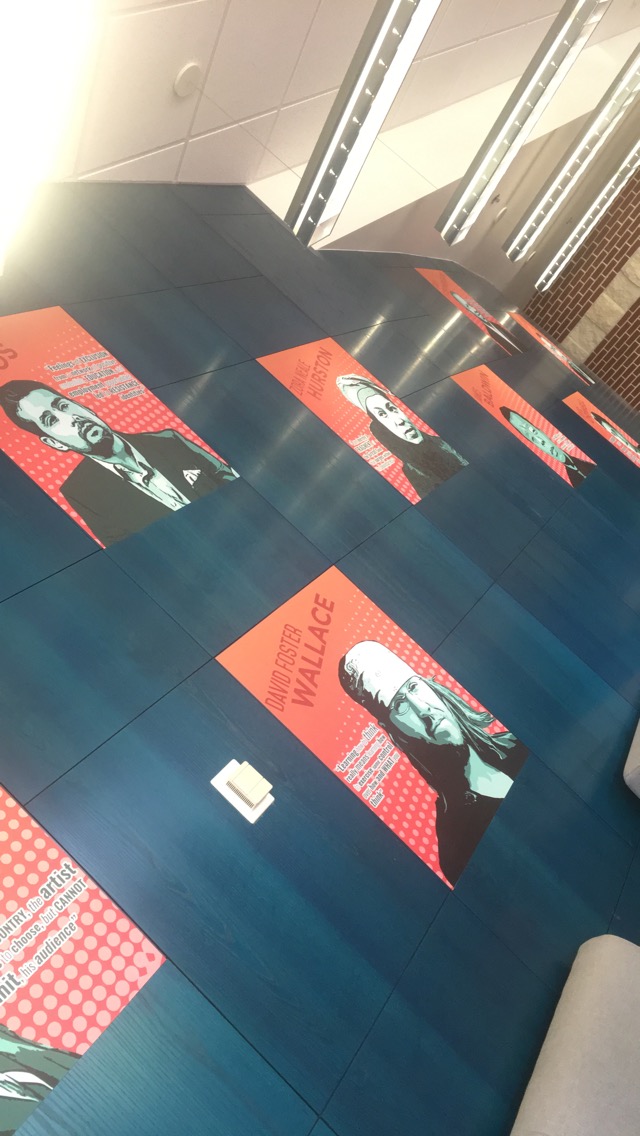
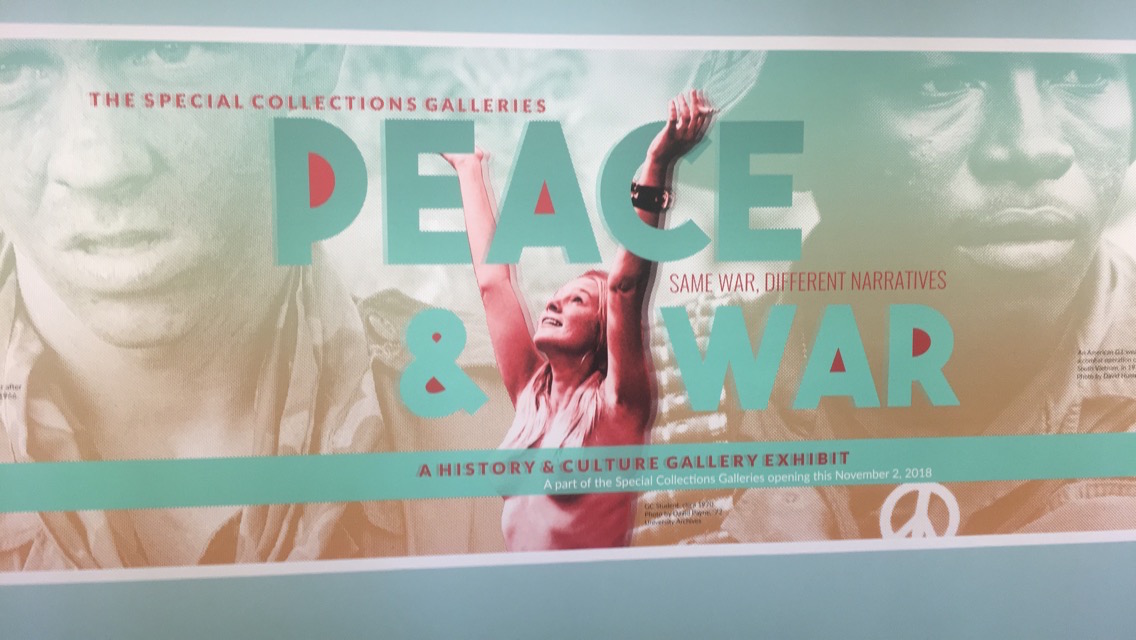
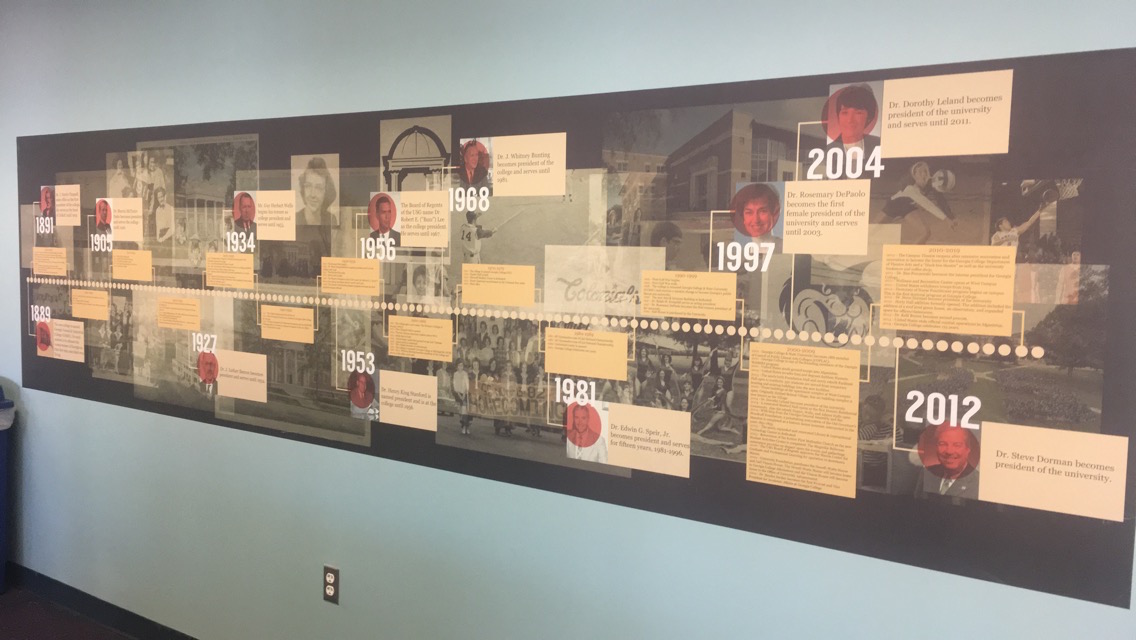

The pictures above show the narrative of Ina Dillard Russell Library: a place where stories are exchanged. The library is full of mediums that share stories like magazines and books. It also has symbols which tell their own stories and require cultural knowledge, like the cutout of Gandalf. It also shares stories specifically about Georgia College with posters on the walls telling the history of Georgia College. Finally, it has places where we, as storytellers, viewers and listeners can share our own personal stories and narratives, in a place of comfort like the chair shown above.
Mini Blog Post #4
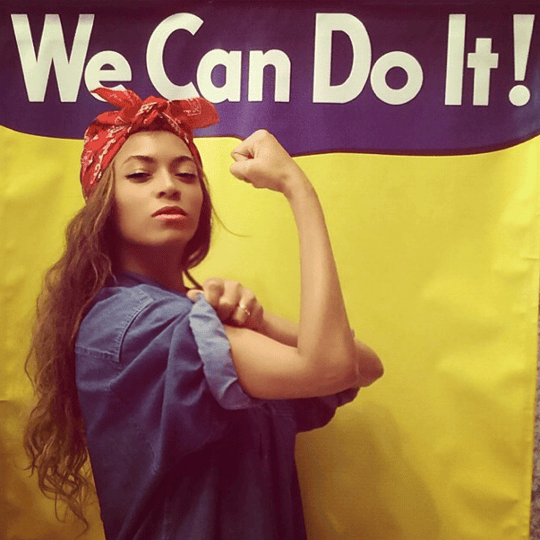
Edwards and Winkler defines an ideograph as a concept “culturally grounded, summarizing and authoritative terms that enact their meaning by expressing an association of cultural ideals…within the rhetorical environment.” This image is a picture of Beyonce imitating Rosie the Riveter in an effort to bring awareness to woman empowerment. The ideograph that I will focus on in this image is empowerment and feminism. This image goes to show that woman are fully capable of taking care of themselves and have the right to be heard. She is a model for woman, answering the question, “Who Runs the World?” GIRLS! This image portrays strength to a culture where woman are often seen as lesser than. Beyonce is flexing her arm like Rosie in order to show her power. Rosie the Riveter was bringing awareness to the woman in World War II who worked hard in factories. This image in today’s culture also is seen as an means to bring empowerment to women and show their strength and rights to work. Visual ideographs can elicit various responses, but will most often leave an impact on the viewer.
Mini Blog Post #4

The ideograph on display in this painting of the surrender at Appomattox Courthouse is one of victory, peace, and unity. This image plays off of the desire to show Ulysses S. Grant and Robert E. Lee as rivals fighting on opposite sides coming together for the first time in agreement. This also plays to the narrative of the Confederacy as desperate, noble soldiers fighting to protect their homeland. The reputation of Robert E. Lee is protected in this image because he is standing tall, looking into Grant’s eyes, and respectfully shaking his hand. Even today, this narrative of the honorable rebels reluctantly surrendering and joining into the union exists. As a culture, we do not like to acknowledge the more brutal aspects of our ancestor’s history, which makes this image which focuses on peace and unity more palatable.
MBP #4

For my fourth Mini Blog post I choose this image because it is recognized by many Americans and we all understand the meaning that it portrays. A visual ideograph uses an abstract concept to advance support for specific political positions. For example, the words freedom, liberty, and justice are the building blocks of ideology. Ideology is a system of ideas which form the basis of economic or political theory and policy. These words inspire collective meaning and feeling in which we all have a similar idea of what it means, but there is no coined definition for these terms. The original image of Uncle Sam’s “I Want You” poster attempts to recruit Americans to join in World War 1. This actually helped a lot and many men dropped everything they were doing and enlisted in the war. Today we see more images like the one I choose which plays with the original meaning and makes it into something completely different. The image I used can be seen around the holiday times and tells people that if they spend a lot of money on gifts their family will love them more. This visual ideograph can be interpreted in two different ways: The first way someone can take the image is that if they spend a lot of money their family will love them. The second way someone can take this image is with a deeper meaning that they don’t need spend a lot of money in order for their family to love them, because they already do regardless. Visual ideographs can be interpreted in many different ways, it all comes down to how you derive meaning from the image. This shows that visual ideographs are culturally bounded and can elicit many different meanings across cultures.
MBP #4

The above image shows Leisha Evans, a Black Lives Matter protester, standing up to police officers who are trying to remove her from the road in Baton Rouge, Louisiana. This image shows different ideographs present in the picture, such as <strength> and <determination>. The image shows the ideograph of <strength>, as the one woman wearing a dress and no armor, stands up to two police officers in full gear. In our culture, police officers are seen as incredibly powerful. When Leisha is shown in the image standing up to some of the most powerful societal forces and holding her fists out (also a cultural sign of strength), this portrays an ideograph of <strength>. In addition, this image portrays the ideograph of <determination>. Determination is shown because Leisha looks completely calm and collected; she is determined to continue protesting and show that police brutality is not something she will stand for. In addition, she has a powerful stance; feet apart and fists out is seen as a symbol of strength, determination or even stubbornness.
mbp #4
According to Edwards and Winkler, an ideograph is a picture that evokes some sort of ideology or general concept of a type of ideology. The most common example is that of the flag raising of Iwo Jima. That iconic photograph is a representation of the ideologies of the United States. This is due to the context, the U.S. soldiers, and the American flag in the picture. The ideology that the viewer may feel is that of independence, freedom, and democracy. When looking at an ideograph, the ideology should come to you naturally.

In this visual representation of Jesus, which is one of many similar portraits, the true character of Jesus is not known. This is a picture that was made to represent what Jesus would look like. There is no proof in the pudding that Jesus looked like this, yet we mutually agree that this is a viable representation of Jesus. The ideology that this, or any image of Jesus evokes is one of Christian value. If this picture of Jesus is to be an ideograph, then there is cultural knowledge and context that must be understood. Given any circumstance, an image that pulls from man’s mutually agreed upon representation of Jesus brings with it the morals and ideologies that Christians and the bible itself carry with them. These ideologies make up Christianity, but there are multiple ideologies that this picture evokes. One broad ideology is love, and to love your neighbors.
Mini Blog Post #4

An ideograph is a has four major premises within it. 1. It is an ordinary term or idea, 2. Abstraction representing collective commitment, 3. Warrants power/guides behavior, 4. Cultural bound. For my example, this picture plays into all of these. The first level applied for this picture is ordinary words and pictures of former presidents. The words and pictures of these Americans insights <freedom> and the coloring makes that idea even more apparent. The words, “Faith, Hope, Charity” under each picture connect a sense of American dignity. The important cultural bond is that all of these presidents mirror Obama’s ’08 run for Presidential office. The overall meaning of this picture is greatly influenced and takes on a different meaning because of the cultural context, making it a great example of an ideograph.
Mini Blog Post 4

One of the ideographs that I believe is invoked in this image is self-accomplishment. Winning a championship at the highest level is a difficult feat to achieve for any major athlete. The look of success, accomplishment, and all the hard work paying off are ideographs that I think are being expressed inside this image.
The cultural values are very close related to the ideographs in the image.
We are always told that if we work hard, and dedicate our lives to the passion and hard work that we can achieve whatever we set our mind to do.
Michael Jordan is considered the greatest and one of the most hard working athletes ever, and the ideographs I recently mentioned correlated with the cultural values of achievement in this image are present and expressed.
Mini Blog Post #4

This image conjures up the visual ideography of what most Americans would likely consider <liberty> or <democracy> as a concept, as this image has come to symbolize our willingness to fight for our morals, those being the rights afforded to us by the Constitution. Throughout American history, images like this have been used to represent the dedication of Americans to these principles, even though the reality of this image is that it is an unfortunate side effect of fighting for those freedoms tooth and nail. The image itself could apply to any era wherein Americans were seen as a liberating force, entering a country under threat of fascism, communism, or tyranny and bringing “true” <liberty> and <democracy> to save the day.
Mini Blog Post #4

This image of Rosa Parks sitting at the front of a segregated bus contains many possible readings, both dominant and aberrant. Among these different readings are various kinds of ideographs that could be examined. Some of these ideographs include <liberty> and <freedom>. This image exemplifies the ideograph of <liberty> mainly in the context. Rosa Parks, an African American woman, sat at the front of a segregated bus rather than in “her place” in the back. The viewer can even see her sitting in front of a white male which signifies her defiance and spirit of protest. We see the ideograph of <liberty> in the message Parks is sending: that she will no longer be considered inferior due to the color of her skin. This constitutes an ideograph because of the cultural values it exemplifies. In that particular time period (and sadly even in some situations today) African Americans did not know what true <liberty> felt like while white people experienced true freedom daily. This image reveals an alternate perspective of <liberty> (or the lack thereof) for white people while also resonating with African Americans as something that was/is universally felt.
 Thinking Rhetorically at GCSU